

What is Carbon Capture and Storage (CCS)?
What is CCS?
19 January 2026
Carbon Capture and Storage, or CCS, is a suite of technologies that captures CO2 from exhaust gases or the atmosphere. The CO2 is then stored permanently underground.
Climate change is one of the greatest challenges facing us today. The primary cause is carbon dioxide (CO2), a greenhouse gas that traps heat in the Earth’s atmosphere. Rising CO2 levels have been attributed to the burning of fossil fuels since the Industrial Revolution. To tackle this, scientists and engineers have developed a suite of technologies known as Carbon Capture and Storage (CCS). This article explains what CCS is, how it works, and where it’s used now.
Table of Contents
What is Carbon Capture and Storage?
- What is Carbon Capture?
- What is Carbon Transport?
- What is Carbon Storage?
- What is Carbon Utilisation?
What is Carbon Capture and Storage?
Carbon Capture and Storage, or CCS (also called CCUS – carbon capture, utilisation and storage), is a suite of proven technologies that help us capture CO2 from industrial exhaust gases or directly from the atmosphere. The CO2 can then be transported and stored permanently and safely deep underground.
1. What is Carbon Capture?
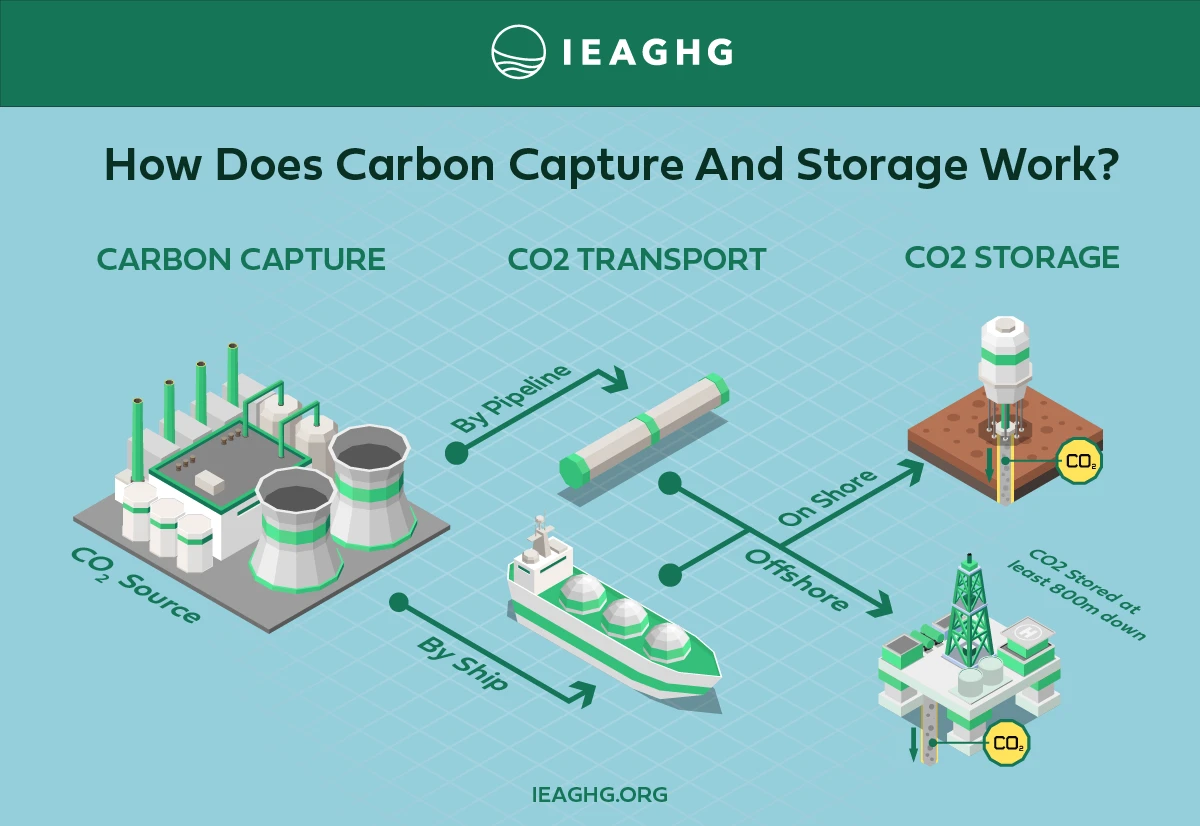
The carbon capture and storage process starts with carbon capture. This involves separating the CO2 from the exhaust gases of power plants or industrial processes (or removing it directly from the atmosphere).
There are five main ways to capture CO2:
- Direct Capture – This is where a plant process produces pure CO2 streams, such as ammonia and ethanol plants, allowing it to be directly siphoned off.
- Post-Combustion Capture – This takes place after the combustion process has taken place (e.g. after fuel has been burnt to produce electricity) and often uses a solvent called an amine to extract CO2 from the exhaust gases.
- Pre-Combustion Capture – This removes CO₂ from the fuel before it’s combusted, often used in hydrogen production.
- Oxyfuel Combustion Capture – This burns the fossil fuels in oxygen to produce water and CO2. These are then separated from the exhaust gas.
- Direct Air Capture (DAC) – This method removes CO₂ directly from the atmosphere. This is a “negative emissions” technology since it can extract more CO₂ than it emits.
These methods of CO2 capture use well-known technologies that can effectively reduce emissions that would otherwise be released into the atmosphere or remove them after they have occurred.
2. What is Carbon Transport?
Once CO₂ has been captured, it is treated or purified, then moved to a suitable storage (or utilisation) site. This usually happens through pipelines or specially adapted ships. Other methods of CO2 transport include road and rail.
Before transport, the gas is often compressed into a dense, fluid-like state called supercritical CO₂. It can then flow efficiently through pipelines or be shipped safely to its storage location.
3. What is Carbon Storage?
Geological Carbon Storage is the process of storing CO2 permanently in porous rock at least 800m underground.
To safely store CO2, the formation must have a suitable ‘reservoir’ rock to hold the CO2 and an impermeable sealing rock on top of the reservoir to prevent the CO2 from rising upwards underground. The reservoir rock is porous (e.g. sandstone), meaning it is full of tiny spaces – like a sponge – that trap the CO2. The sealing rocks above are impermeable (e.g. shale), meaning that the CO2 cannot pass through them, trapping itbelow. CO2 is always stored deep underground, providing secure storage. This ensures it is permanently trapped in the rock layers.
There are a variety of types of geological formations used for CO2 storage, including:
- Deep saline aquifers – layers of porous sedimentary rock filled with salty water in between tiny spaces between the grains in the rock.
- Depleted oil and gas reservoirs – former oil and gas fields that are now unused. The oil/gas used to be in the tiny spaces within the reservoir rock, and are now empty, ready for CO2 injection.
- Volcanic rocks – CO2 can be stored in rocks like basalts (lava flows). Here, the CO2 is converted into solid minerals, in addition to being trapped in holes in the rock.
The underground storage of CO2 is not a new concept; it has actually been happening since 1972 in the oil and gas industry for ‘enhanced oil recovery’. This historical practice, along with many large-scale and demonstration CCS projects worldwide, shows that CO2 can be stored safely and permanently underground. Furthermore, underground storage capacity globally is massive and can meet our foreseeable needs far into the future.
4. What is Carbon Utilisation?
The “S” in CCS stands for storage, but the term CCUS is used when “utilisation” is involved (i.e. turning the CO2 into a useful product or tool).
These are the main ways that CO2 can be utilised:
- Enhanced Oil Recovery (EOR) – The CO2 is injected into mature oil fields, increasing the pressure underground and forcing out more oil from these reservoirs, whilst leaving much of the CO₂ stored underground.
- Creating new low-carbon products – CO2 is increasingly being used to make fuels, chemicals or concrete additives to lower the overall carbon emissions of the product. However, many forms of this type of utilisation only offer temporary storage of the CO2 for tens or hundreds of years, whereas geological storage (injecting the CO2 deep underground) is permanent.
Why Do We Need CCS?
When we burn fossil fuels (coal, oil, natural gas) or run certain industrial processes (like cement or steel making), CO2 is released into the air. Over many years, this has built up in the atmosphere and is driving global warming.
To limit global temperature rise, humanity must drastically reduce CO2 emissions. In 2015, as part of the ‘Paris Agreement,’ countries agreed to limit global temperature rises to 1.5°C compared to pre-industrial levels. However, in many “hard to decarbonise” sectors — such as heavy industry, cement, steel, and chemical manufacturing — it’s very difficult, or even impossible, to eliminate all emissions. CCS is a valuable tool that can drastically reduce the carbon emissions in these sectors.
The United Nations Intergovernmental Panel on Climate Change (IPCC), the International Energy Agency (IEA), and many governments around the world have acknowledged that CCS is an essential tool to help us achieve net zero, and it is a critical part of many net-zero forecasts. Indeed, the UK government’s Committee on Climate Change stated that ‘CCS is a necessity, not an option.’
What are the benefits of CCS?
- CCS reduces emissions – Existing power plants, infrastructure, and heavy industries can have their CO2 emissions significantly reduced.
- Reduces emissions in ‘hard-to-abate’ sectors – Allows the decarbonisation of sectors such as cement and steel where other alternatives are very limited or even non-existent.
- It enables negative emissions – When combined with bioenergy, waste-to-energy or direct air capture, these technologies can remove more CO2 from the atmosphere than they emit. This offsets emissions from other sources, such as air travel, for which there is no ideal decarbonisation solution.
- Complements renewable energy – CCS can complement renewable energy sources such as wind and solar as it can help us to generate low-carbon power on demand when renewable production drops, e.g. when it is dark or the wind isn’t blowing.
Where is CCS in use now?
Up until 2024, a total of 383 million tons of CO2 had been safely stored underground. According to the Global CCS Institute, as of October 2025, 77 commercial carbon capture and storage projects were operating, capturing 64 million tons of CO2 per annum. There are a further 47 under construction, and 610 projects in development. According to the CO2RE project database, a total capture capacity of 337 million tons of CO2 per annum by 2030 is forecast. Global support from governments and the private sector is growing rapidly, demonstrating that CCS is a viable technology to help us combat climate change.
Other articles you might be interested in
Get the latest CCS news and insights
Get essential news and updates from the CCS sector and the IEAGHG by email.
Can't find what you are looking for?
Whatever you would like to know, our dedicated team of experts is here to help you. Just drop us an email and we will get back to you as soon as we can.
Contact Us Now