

Risk Management and Monitoring Networks Combined Meeting Report
Nicola Clarke, Samantha Neades, Tim Dixon
Citation: IEAGHG, “Risk Management and Monitoring Networks Combined Meeting Report”, 2026-TR01, January, doi.org/10.62849/2026-TR01
Overview
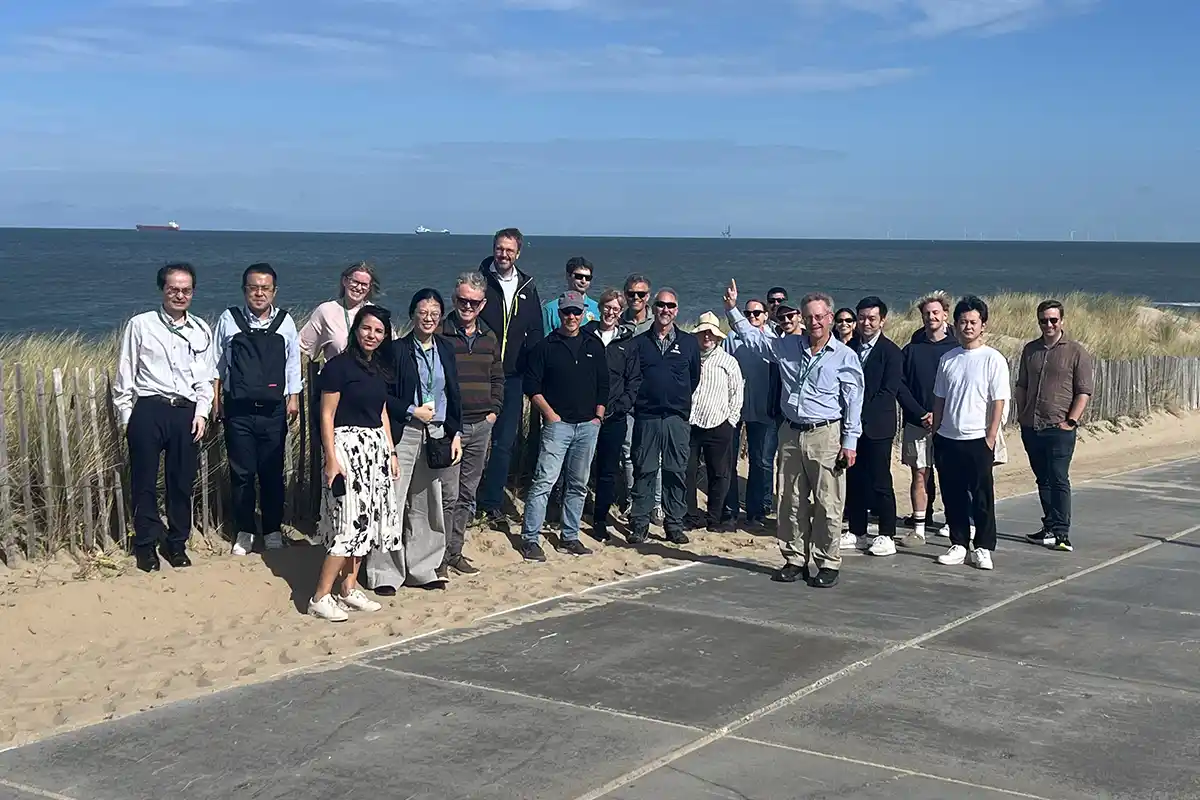
Two IEAGHG expert networks, the Risk Management Network and the Monitoring Network, held a combined meeting from 27th to 28th August 2025 in The Hague, The Netherlands. Both networks have been convening for 20 years, and this meeting, hosted by Shell at the Shell Centre, represented the 11th Risk Management and the 15th Monitoring meeting.
Bringing together over 75 experts, comprised of regulators, operators, research and academic staff, this meeting span across two days to discuss new ideas and probe for deeper insights. The workshop was augmented by a dinner sponsored by Shell and EBN at the Mauritshuis Museum and a post-workshop field excursion to tour the Porthos project.
The purpose of the workshop was to explore the latest thoughts, ideas, developments and technologies related to risk management and monitoring of geological CO2 storage sites. The dedicated Steering Committee curated each session and the overall flow of the workshop.
Summary
On day 1, session one explored ways to maximise storage resources: with a consideration of well abandonment protocols; looking at how classification of aquifers according to regulations influences their availability as a CO2 store; and how management of surface infrastructure from other industries is critical, especially in the marine environment.
Session two included experimental work testing CO2 injection into a fault and exploring monitoring technologies; and fault risk assessment workflows were presented from the DETECT project. One of the biggest risks to a storage site is the presence of legacy wells.
Session three focused on quantification, measurement and materiality of leakage via legacy wells. This included control-release experimental work developing near-surface monitoring, case studies of leaking methane wells from British Columbia, crossflow issues between legacy wells and cement channels and quantifying leakage magnitude.
Continuing the theme of wells, the final session of day 1 honed in on well designs and operations, a timely update from the Decatur Storage site was followed by well design practices in the US and Norway and material choices to manage corrosion.
Finally, a new technique of applying a cement integrity sleeve was described and its potential to preserve self-sealing properties was described.
The second day kicked off with a deep dive into novel monitoring solutions, including down well fibre-optics, seabed fibre-optics, using shear waves as a potential monitoring technique, gravity field monitoring on depleted fields and the latest advances in sparse and cost-effective monitoring.
Session 6 continued to explore risk factors with the goal of investigating what might act to reduce the risk profile of a project through time. Two case studies were presented one on an established project (Quest) and one on a project in planning (Porthos). Multi-physics models were shown to demonstrate how hard it is for CO2 to migrate from a reservoir, and experimental work was presented on the potential of shale creep to aid CO2 containment.
How the scale up of CO2 storage might impact resource allocation, risk factors and what monitoring strategies might be employed was the focus of session 7. This is an area where regulators are focusing considerable attention. The themes of the talks ranged from the risk of induced seismicity from multiple stores, using natural seismicity records to create a unified database and some of the challenges in doing so in the North Sea, monitoring strategies (e.g. using pressure monitoring and fibre-optic strain sensing), and strategies for maximising resource allocation. The final session was a panel discussion focused on the role of insurance and finance in CCS at the project level. The panellists addressed definitions, risk allocation, financial guarantees, and innovative insurance solutions relevant to project developers, lenders, insurers, and regulators and engaged in a detailed discussion session with the audience of technical experts.
The workshop concluded with a dedicated closing session aimed at distilling the learnings and promoting action points for further recommendations as outcomes of the meeting. These are summarised at the end of this report.
Our most recent publications
Our authoritative, peer-reviewed publications cover topics that include carbon capture, transport, storage, monitoring, regulation, and more.
View All Publications
Get the latest CCS news and insights
Get essential news and updates from the CCS sector and the IEAGHG by email.
Can’t find what you are looking for?
Whatever you would like to know, our dedicated team of experts is here to help you. Just drop us an email and we will get back to you as soon as we can.
Contact Us Now