

CO2CRC Symposium: The role of CCS in confronting energy realities
News & Blogs
4 March 2026
CO2CRC Symposium 2026 brought together experts, government leaders, industry executives, investors, and researchers to explore emerging opportunities and challenges.
Taking place on 23-25 February, the CO2CRC Symposium 2026 brought together Australian and international experts, government leaders, industry executives, investors, academics, and researchers to explore emerging opportunities and challenges over 2 full days of the conference in Melbourne, along with a workshop on the first day and a site visit to the Otway International Test Centre on the final day. This is an important time for CO2CRC as it proposes a national bid for a ten-year A$200 million R&D programme, building upon its great achievements over the past 23 years.
Day 1: CO2CRC Symposium Workshop and welcome reception
The first day began with an engaging workshop looking at ‘Optimised CO₂ Storage Monitoring: Pathways to Performance, Confidence & Closure’. The audience heard updates from CO2CRC experts on some of the latest work in CO2 Storage Monitoring and had the opportunity through a practical workshop to explore the risks and considerations in injection and monitoring through different lenses.
The conference then fully kicked off with welcome drinks sponsored by INPEX, which provided an excellent opportunity to connect. A highlight of the reception was seeing the chair of the IEAGHG International CCS Summer School Steering Committee, John Kaldi, receive a Lifetime Achievement Award for his contribution to CCS over the last 2 decades.
Day 2: Plenaries, Technical Presentations and Gala Dinner
On the second day of the CO2CRC Symposium, we heard from the Chairman of CO2CRC – Martin Ferguson, and the Chief Executive Officer – Dr Matthias Raab, as the welcoming addresses. Matthias had two strong messages for CCS sceptics: “Do your homework” and “Face the energy reality”. This was followed by an excellent talk on reflections, perceptions and projections from Professor Peter Cook (a former recipient of IEAGHG’s Green Award). Peter celebrated twenty years of the Otway International Test Centre as a field research facility of CO2 geological storage. Both Matthias and Peter drew attention to the growth in energy demand caused by AI data centre growth, and the potential for this to be low-carbon gas power with CCS.
The conference keynote was given by Minister Madeline King, who affirmed the Australian Government’s commitment to CCS by saying:
“To get to net zero, we will need to draw on every tool at our disposal. There are no silver bullets when it comes to addressing climate change, and all efforts will be required to meet net-zero targets. Large-scale carbon capture and storage must be part of that effort.”
The plenary session continued for the second half of the morning and included presentations on:
- Confronting new realities: the shift to energy evolution, emerging technology pathways, and the CCUS imperative by David Brown, Woodside Energy. He noted the energy ‘addition’ that is taking place more than an energy ‘transition’, and the potential business for Australia in receiving seaborne CO2.
- Speed Bumps on the Road to Net Zero Australia by Rick Wilkinson, EnergyQuest. These included the low price of ACCUs.
- Natural gas export and CO2 import opportunity: unlocking Australia’s potential by Bill Townsend, INPEX
The morning concluded with an interesting panel discussing ‘Making CCS commercially viable – what needs to change?’ that discussed this question both in an Australian context, in addition to learnings from other nations developing CCS. The panel included David Brown, Wood Mackenzie; David Fallon, Chevron; Cameron McPhie, INPEX, Yvette Manolas, and CO2CRC; it was facilitated by Perry Wilson, Rystad Energy.
The afternoon broke out into technical plenaries, including presentations on the following topics:
- Advancing Capture: Pathways to Deployment. This included that a large industrial emitter in Australia is the aluminium sector, which is also a high-value-added export for Australia. Also, the great potential for engineered CDR in Australia by Paul Feron of CSIRO.
- Understanding Scale in Reservoir Characterisation
- Unlocking New Storage Potential Through Optimisation. This included work on the injection of CO2 microbubbles to improve storage efficiency and the planned field test at Otway.
There was also the opportunity to engage with poster presenters in the form of 3-minute flash talks that covered the chain of CCS.
The Gala Awards Dinner was hosted on the evening of the second day and sponsored by Santos. This was an excellent opportunity to engage and connect with new and old colleagues from across the CCS chain.
Day 3: Plenaries and Technical Presentations
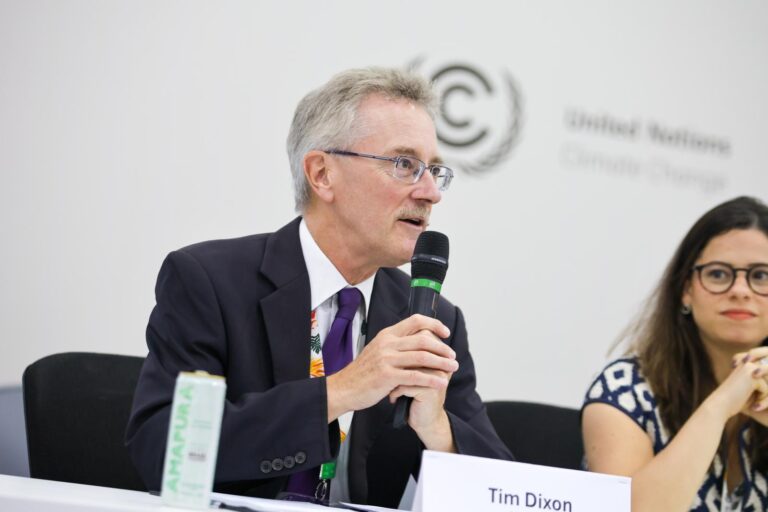
Day 3 started with a look beyond Australia to what was happening with CCS in the Asia Pacific. The audience heard interesting talks and learnings with Mark McCallum, Low Emissions Technology Australia presenting on Cleaner Ways to Mine, Make and Build: Aligning Industry, Technology, Projects and Policy in Australia and the Region for CCS at Scale; David Kearns, Global CCS Institute presenting an update on CCS in the Asia Pacific; Anggit Raksajati giving an interesting update on Indonesia’s CCS Landscape (there is really a lot going on in terms of policy and in projects); Our own Tim Dixon presenting an insightful talk on London Protocol, Paris Agreement Article 6.4, IPCC and ‘How These Support Transboundary CO2 Imports’ (and COP30 outcomes and GHGT-18 promotion); David Robinson, Geoscience Australia updating the audience on Australia’s carbon dioxide storage potential as an asset for regional emissions reduction and closing with a thought provoking talk from Andrew Garnett, University of Queensland addressing the question “Is Australia losing its competitive edge in CCS?” (his conclusion -it could be).
Technical presentations continued after the morning break and lunch, and included:
- Verifying Storage: Established and Emerging Monitoring
- Australian Onshore CCS: Progress and Perspectives. This included lessons from the CTSCo project, which was stopped by the Queensland government’s prohibition on onshore storage. This session also included an update on the successfully operating Moomba CCS project by Santos.
- Delivering Scalable CO2 Storage for the Energy Transition. This included the role of standards by ISO and verification, and a review of the projects in development in the ASEAN region, and the proposed ten-year R&D programme by CO2CRC.
- Deriving Value from Fault Studies and Field Experiments. This included the results from CO2CRC’s world-leading Otway Shallow Fault Experiment, where they injected 16 tonnes of CO2 into a fault at 70m depth and monitored the resulting CO2 behaviour.
The CO2CRC Symposium schedule concluded on day 3 with talks on the need for CCS globally by Professor Sally Benson, more on the Moomba CCS project by Matt Densley of Santos (now at 1.7Mt injected and stored already), an update on the Gorgon Project by David Fallon of Chevron (now at 12Mt CO2 injected and stored, and with an improved pressure management system).
A recurring theme which struck me was on transboundary CO2 shipping from countries without enough storage, the growing number of MOUs between countries and companies in the ASEAN region, in general and especially for transboundary CCS, and the potential for Australia to benefit from this new area of business.
Day 4: Otway International Test Centre
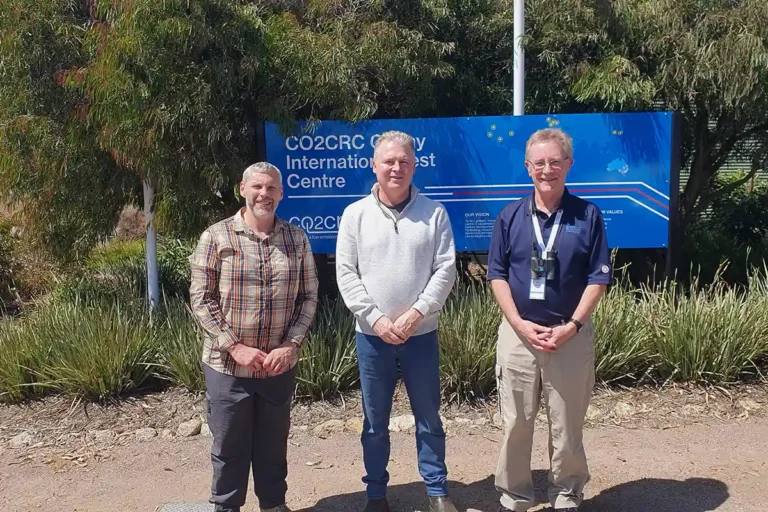
Day 4 was an opportunity to visit the Otway International Test Centre. The last time I visited was in 2018, and then there were two active wells, this has since increased to eight. So much good science has taken place in the intervening period using the data from the facility. It is also a model of best practice in community engagement, with six-monthly meetings still being supported by the local community after some twenty years.
The CO2CRC Symposium was a fascinating insight into what is happening with CCS in Australia currently, with some deep-dive sessions into different technical aspects of CCS. It allowed for some excellent discussions and networking with colleagues and highlighted some of the areas where Australia is at the forefront of development through effective collaboration.
Other articles you might be interested in


Get the latest CCS news and insights
Get essential news and updates from the CCS sector and the IEAGHG by email.
Can't find what you are looking for?
Whatever you would like to know, our dedicated team of experts is here to help you. Just drop us an email and we will get back to you as soon as we can.
Contact Us Now