

Energy Innovation Takes Centre Stage in Paris: Highlights from the IEA Energy Innovation Forum 2026
News & Blogs
23 February 2026
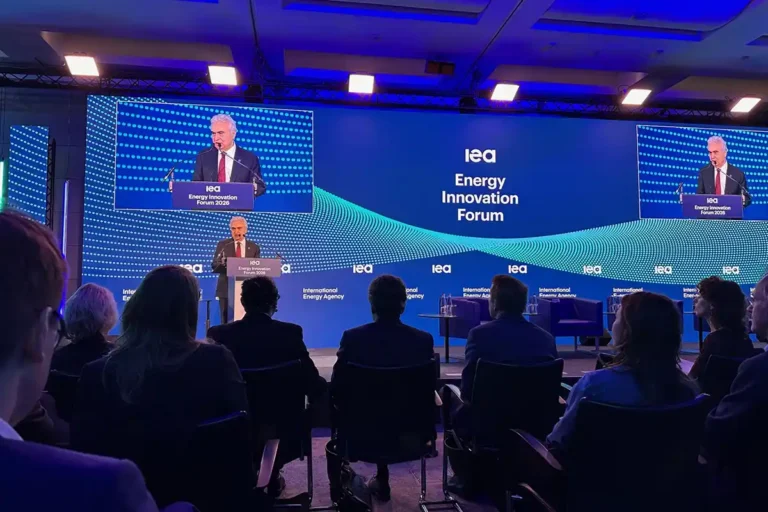
On 18 February, the International Energy Agency (IEA) convened its third Energy Innovation Forum in Paris, held alongside the biennial IEA Ministerial Meeting and co-hosted by the Netherlands. The event brought together ministers, industry leaders, investors, and several IEA Technology Collaboration Programmes (TCPs) – including IEAGHG – for a full day of discussion, insight, and strategic thinking around the future of global energy innovation.
This year’s Forum also marked the release of the second edition of The State of Energy Innovation, the IEA’s flagship assessment of global progress in energy technology. The report offered a deep analysis of public and private R&D trends, venture capital flows, patent activity, and key policy developments, as well as updates on the IEA’s 18 “Races to First” priority innovation tracks.
A Full Agenda: From Opening Insights to Deep-Dive Discussions
The day opened with a packed programme: high-level addresses, panel discussions, the launch of the IEA’s new report, plus ministerial exchanges, breakout sessions, and roundtable conversations.
CCUS (carbon capture, utilisation and storage) took a prominent role, with notable showcases from Canada, Norway, and the Netherlands. Highlights included:
- Canada’s large-scale CCUS ambitions, including support for oil sands decarbonisation via the Pathways CCS project;
- Norway’s operational CCS projects, strong R&D funding, and policy stability, highlighted by Energy Minister Terje Aasland;
- The Netherlands’ Porthos project, a contender in the global race to build the first multi-source CO₂ storage hub;
- Companies such as 1PointFive, aiming to deliver the world’s first half-million‑tonne CDR plant.
Setting the Stage: Opening Remarks and Early Discussions
Bloomberg senior reporter and author Akshat Rathi moderated the morning session. Dutch Deputy Prime Minister Sophie Hermans opened the Forum before handing over to IEA Executive Director Fatih Birol, who outlined the scale of the challenge and the IEA’s expanding analytical and convening role.
Dr Birol noted that the IEA now tracks around 600 energy-related technologies, including TRLs and investment trends. Innovation, he stressed, requires not just good ideas, but stable, long-term policy support. He also announced that Mission Innovation would be moving under the IEA umbrella.
A short film celebrating the history of IEA TCPs – dating back to the 1970s – followed.
Innovators on Stage: Startups, Finance, and the Realities of Deployment
A lively panel discussion featured:
- Kiki Lauwers, CEO, Thorizon
- Aurore Belfarge, founder of SusTechable
- Sorin Grama, CEO, Trasaera
Thorizon and Trasaera are pushing forward with modular molten‑salt reactors and MOF-based cooling systems respectively, while Belfarge brought the perspective of early-stage financing.
Key themes included:
- The challenge of turning ideas into viable products
- The need for government risk-taking
- How domestic markets can serve as proving grounds
- The importance of valuing the cost of inaction, not just capital costs
The Launch: The State of Energy Innovation 2026
The IEA’s newly-released report highlighted two major themes: energy security and energy innovation. Among the insights:
- Global public R&D spending has declined as a share of GDP, from 0.1% in 1980 to 0.05% in 2024.
- Venture capital investment in energy start-ups has fallen, though corporate R&D has grown.
- Lithium batteries dominate patent filings, accounting for half of all new energy patents.
- China is now the largest holder of energy-related patents.
Ministerial Fire-Side Chat: Global Challenges, Local Realities
Energy leaders from Canada, Norway, Kenya, and the European Patent Office shared their perspectives.
Among the standout insights:
- Tim Hodgson, Minister of Energy and Natural Resources, Canada, emphasised climate-focused competitiveness and plans for major CO₂ storage through the Pathways CCS Project.
- Terje Aasland, Minister of Energy, Norway, highlighted its decades-long CCS leadership and called on Europe to capture CO₂ that Norway can store offshore.
- James Opiyo Wandayi, Minister of Energy and Petroleum, Kenya, emphasised the financing barriers facing African nations, while showcasing its geothermal success – now providing 45% of national electricity and recent developments in energy policy.
- Stephen Rowan, VP of the European Patent Office, noted soaring patent growth (up 800% in China) and the dominance of batteries, fusion, solar PV, and CCUS in filings, alongside new patent support tools and fee reductions.
The session reinforced that different regions require different technology pathways – and that stable policy is a universal prerequisite for innovation.
Breakout Sessions: Scaling Sustainable Fuel Pathways
IEAGHG participated in the breakout session on ‘Scaling Up Emerging Sustainable Fuel Pathways’, held under Chatham House rules. Discussions centred on:
- Drivers for investment
- Key milestones for the next decade
- Policy measures to unlock progress
Important messages included:
- Customers will adopt low-carbon products when costs align.
- Fossil fuel infrastructure enjoys a long-standing advantage; new mechanisms are needed to offset capital risk.
- AI could accelerate discovery and optimisation.
- Policy promises from 2020 must be honoured – waiting for cost reductions will stall progress.
Afternoon Focus: First-of-a-Kind Projects & 12-Month Priorities
A roundtable chaired by the European Commission’s Joanna Drake showcased first-of-a-kind projects competing in the IEA’s “Race to Be First”:
- Porthos – CCS (Netherlands)
- HyPSTER – hydrogen storage (Storenergy)
- Stegra – H2 Green Steel (Sweden)
- Hylron – green iron production
Another roundtable, led again by Akshat Rathi, explored priorities for the next year with contributions from Sara Aagesen Munoz (Third deputy prime minister of Spain and Minister for the Ecological Transition and the Demographic Challenge); Ed Miliband (Secretary of State for Energy Security and Net Zero, UK); Elisabeth Zehetner (State Secretary for Energy, Startups and Tourism, Austria); and COP30 President André Aranha Corrêa do Lago. Messages included:
- Celebrate the progress already made, and the 190 countries that reaffirmed the Paris Agreement.
- Set ambitious, actionable goals
- Accelerate grid expansion: “There is no transition without transmission”
- Strengthen circularity, supply chain resilience, and social innovation
- Leverage Mission Innovation’s closer alignment with the IEA
Closing Reflections
IEA Chief Energy Technology Officer Timur Gül concluded the day with a concise summary and looked ahead to continued progress. Austria announced it will host the next Forum in Vienna in 2027.
IEAGHG extends its thanks to the IEA and the Dutch government for an insightful, collaborative and forward-looking event
Other articles you might be interested in

Get the latest CCS news and insights
Get essential news and updates from the CCS sector and the IEAGHG by email.
Can't find what you are looking for?
Whatever you would like to know, our dedicated team of experts is here to help you. Just drop us an email and we will get back to you as soon as we can.
Contact Us Now