

Time to Deliver: HyNet Project 2026 Conference
News & Blogs
25 March 2026
The HyNet Project 2026 conference celebrated one of the UK’s most inspiring infrastructure stories, as the CCS Hub becomes a reality.
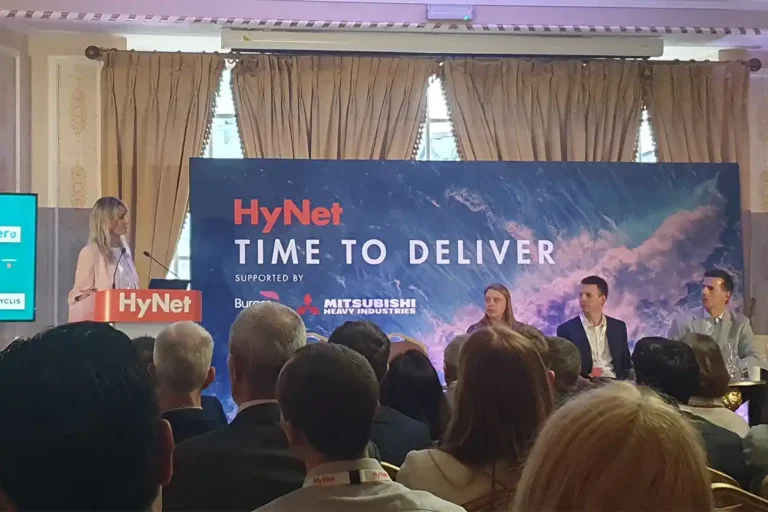
It was exciting to be invited to the HyNet 2026 conference in Manchester on the 24th March. Titled “Time to Deliver”, this conference celebrated one of the UK’s most inspiring infrastructure stories and especially the parts of the project that have reached final investment decisions (FID) and are under construction (transport, storage and the first two CO2 sources).
Eleanor Lewis, a PhD student working for the HyNet Project, gave the keynote address. This was a powerful message about the future skilled jobs and careers being created, including those stimulated by the HyNet project’s apprenticeship scheme.
Bruce Becker from Liverpool Bay CCS (LB CCS) gave an update on the construction of the Transport and Storage (T&S) project. LB CCS is part of Eni CCUS Holdings, an Eni satellite company. This is re-purposing three depleted gas fields in Liverpool Bay and one pipeline offshore. The new offshore Douglas Hub Platform is under construction, and installation is planned for later in 2026. The offshore CO2 pipeline and power sources will leave from the Point of Ayr. Bruce estimated that construction is 25% complete. Operational readiness is planned for late 2028 with a capacity of 4.5Mtpa by 2030, and has the potential to increase 10Mtpa by 2035.
Tim Roth of United Infrastructure presented an update on the construction of the main CO2 pipeline onshore, which has a total of 772 ‘crossings’, of which 55 are trenchless ‘complex’ crossings. Some of the more visible are generating positive interest from the public.
Matt Hayes [check] of Heidelberg and Andrew Bellis of Worley presented on the Padeswood Cement plant CO2 capture project under construction. This site will use MHI’s amine capture technology to capture 800ktpa by 2029 at an 85% capture rate. The near-zero emission cement will be marketed as EvoZero (as is the cement from their Brevik plant).
Andy Bedford of Encyclis gave an update on their waste-to-energy plant capture project at the Protos site. This will capture 370kt CO2 pa. 50% of the input waste-stream fuel is biogenic, and when captured and stored, the CO2 will count as a removal from the atmosphere. He used the analogy “BOGOF” for this CO2 performance, as in ‘Buy One Get One Free’! As a comparison, this CO2 removal is equivalent to that of 7.5 million oak trees.
Regional and political perspectives were given by Andy Burnham (Mayor of Greater Manchester), Steve Rotheram (Mayor of Liverpool) and Louise Gittins (Cheshire and Warrington Combined Authority). A central theme and phrase used by many was “industrial decarbonisation and economic regeneration” instead of de-industrialisation and offshoring of industry and emissions (which has been happening to date).
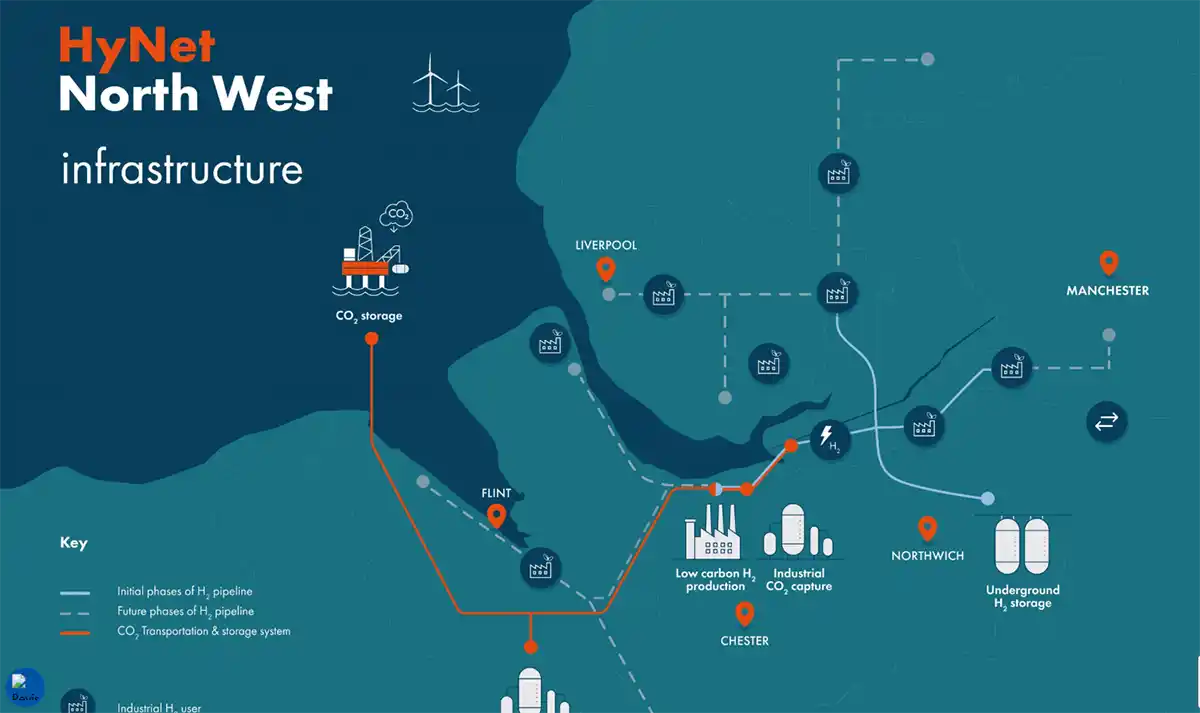
In the afternoon, CO2 source projects in the pre-FEED and FEED stages were presented. Ruth Herbert and Richard Holden from Essar Energy Transition gave updates on their Stanlow refinery’s CCS projects based on CCS-enabled hydrogen production. They will be the provider of low-carbon hydrogen to the region’s industries. Additionally, on the government’s priority list are Evero’s BECCS EfW project at Ince based on waste wood, and Uniper’s new-build CCGT at Connah’s Quay. ‘Next phase’ projects presented were Enfinium’s EfW project at Parc Adfer, Viridor’s EfW project at Runcorn, a second Essar CCS project, and Climeworks DAC project.
Overall, an exciting day of updates, seeing the reality of CCS construction projects in the Northwest of England and North Wales. I also recommend the HyNet project website, which has a wealth of information on all construction projects and their status.
Many thanks to Progressive Energy for the invite, and especially for their perseverance and hard work over decades in making the HyNet project a reality with UK government and local industry support. It is worth noting a rumour of an early seed that was sown by the IEAGHG report “Distributed CO2 Collection” (2007-12), which chose the HyNet region as the case study for a potential CO2 cluster and hub. Now it is a reality!
Other articles you might be interested in

Get the latest CCS news and insights
Get essential news and updates from the CCS sector and the IEAGHG by email.
Can't find what you are looking for?
Whatever you would like to know, our dedicated team of experts is here to help you. Just drop us an email and we will get back to you as soon as we can.
Contact Us Now