

Financing CCS: insights from New York Climate Week 2026 (with CCS & Football!)
News & Blogs
28 September 2026
New York Climate Week is a well-established annual get-together timed to coincide with the UN General Assembly in New York.
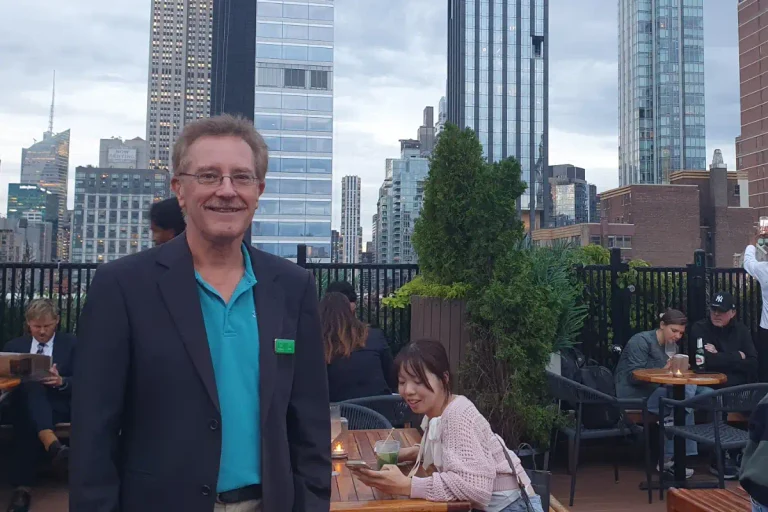
New York Climate Week is well established as an annual get together timed to coincide with the UN General Assembly in New York. It brings together the private sector who are active in climate change mitigation as well as other non-state actors such as academic institutions, with carbon markets being one of the common themes. This year there were over 1,000 events throughout the week. In recent years, the Global CCS Institute had organised an event each year to focus on CCUS.
The event this year, organised by the Global CCS Institute, was on the theme of CCS Finance, and hosted by Latham & Watkins LLP. This was the main CCS-focused event at New York Climate Week and it had a good attendance of over 100 people. This half-day event had sessions, each focusing on a different aspect relating to the overall theme. The event was under Chatham House rules, so only general points will be mentioned here.
The first session focused on What Gets a Project to the Finish Line, and had speakers from project developers, buyers of low-carbon energy, and lawyers. The discussion focused on financing CCS projects in the USA, emphasising the value of the 45Q tax credit for projects and its continuation under this Administration. Positively engaging local landowners, costs of capture, and insurance were also discussed.
Possibly a first for CCS, a new connection for me was between CCS and sport! This arose from the project built and recently operating by Carbon TerraVault JV in California. This is capturing CO2 from a cryogenic gas plant and storing it in a depleted oil and gas reservoir at Elk Hills. It has stored 30kt so far since first injection in May. Capturing from a CCGT will be next. As well as showing that CCS projects are possible in California, another interesting aspect was the engagement with the local community. They have good relations by being directly engaged with the local NFL football team, the Los Angeles Rams, enabling the team to offset their emissions. This initiative has a great title, “Football without the Footprint”!
The second session was on Financing Barriers and Opportunities. This panel was composed of bankers, consultants and lawyers. Again, 45Q was discussed, its value and also its relative complexity compared to tax credits for other technologies. I am pleased to see that the ‘Safe Harbour’ to claim the credits for straight storage using EPA’s Subpart RR has been extended, given the proposed repeal of EPA’s GHG reporting rules. Last year’s event had AI Datacentres as the theme, highlighting their need for large quantities of low-carbon reliable electricity. However, this time the discussion was not about building them powered by natural gas with CCS from new, but building them ready for CCS to be fitted in the future.
The next session was on Environmental Attributes, ie carbon credits and verification methodologies, and on low-carbon-electricity certificates. The final session was on Emerging Technologies, and this covered alternative capture technologies to amines, the difficulty in retrofitting existing fleets of CCGT power plants, hence the need for DACCS, and storage in un-minable coal seams.
As always, there was great value in the side conversations. Many thanks to the Global CCS Institute for this event.
With New York Climate Week hosting over 1,000 events spread across the city, it is difficult to fit many in, but I did sample a polar geoengineering event which covered techniques such as Sea Curtains, Stratospheric Aerosol Injection, and Basal Ice Sheet Water Removal. These reminded me of the marine geoengineering techniques under ongoing discussion in the London Convention, as the efficacy and impacts of these techniques are very uncertain, and they make conventional CCS, DACCS and BECCS look very straightforward, low impact, and easy!
The Carbon Business Council’s “Carbon Removal Community Reception” and the early morning NYCW 5k RunClub in Central Park were both very well attended and provided good opportunities to network with colleagues old and new from around the world.
IEAGHG has many members from the USA, and this provided useful catch-ups and a sense of the evolving CCS business atmosphere there. Overall, it seems that commercial-scale CCS projects continue to progress in the US.
For more information on “Football without the Footprint”, see Football Without the Footprint – California Resources Corporation
Other articles you might be interested in
Get the latest CCS news and insights
Get essential news and updates from the CCS sector and the IEAGHG by email.
Can't find what you are looking for?
Whatever you would like to know, our dedicated team of experts is here to help you. Just drop us an email and we will get back to you as soon as we can.
Contact Us Now