


Reflections from the Carbon Storage MMV Technology Showcase at EAGE 2026
News & Blogs
11 June 2026
Measurement, Monitoring and Verification (MMV) is a fundamental technical requirement for CO₂ storage. MMV has quietly matured into one of the most capable parts of the storage chain, and the questions now occupying the field are exactly the right ones.
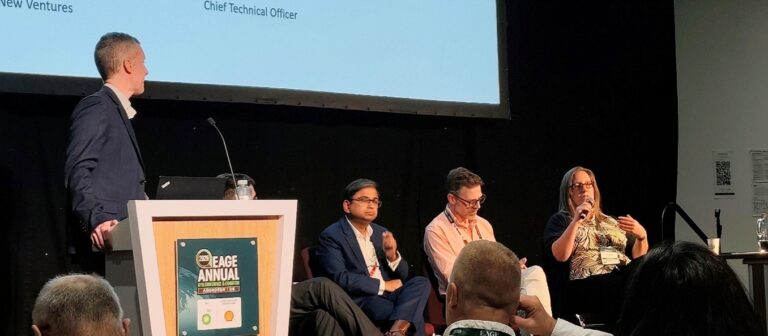
The opening day of EAGE Annual in Aberdeen hosted the Carbon Storage MMV Technology Showcase, organised by the North Sea Transition Authority. It gave good reason for confidence in the readiness of CO₂ storage monitoring.
Measurement, Monitoring and Verification (MMV) is a fundamental technical requirement for CO₂ storage. MMV has quietly matured into one of the most capable parts of the storage chain, and the questions now occupying the field are exactly the right ones.
Plenary talks at the showcase covered monitoring plans and technology selection, well and reservoir monitoring, and environmental monitoring, while parallel showcase sessions ran alongside. Presenters held screens for a full hour and repeated their talks, allowing delegates to move between presentations, exhibitor stands and posters. With storage operators, technology suppliers, universities and public bodies all represented, the conversations moved naturally between research, hardware, regulation and deployment.
A recurring theme was that monitoring is not a single discipline. It is a whole-project effort involving subsurface, facilities, drilling, regulatory, commercial and communications expertise. That framing matters because it positions MMV not as just a downstream check, but as something woven through a project from the start. Increasingly, the direction of travel is towards integrated, model-driven views of storage sites rather than disconnected measurements gathered in isolation.
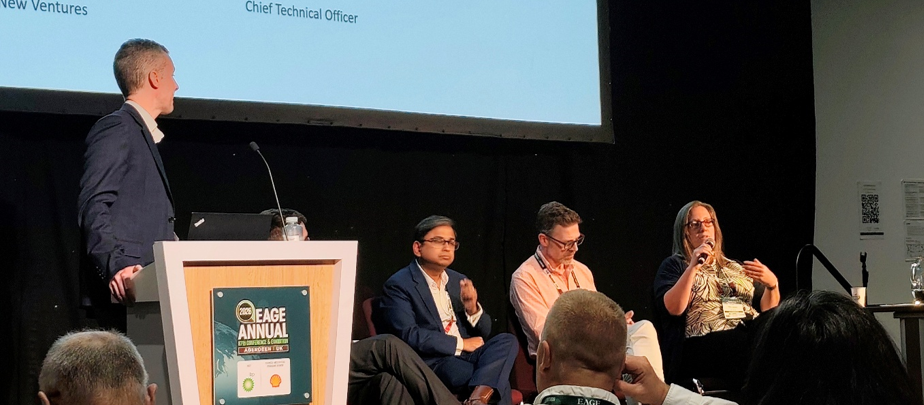
Snam offered a useful reminder that CCS is not starting from a blank page. Its onshore underground gas storage operations in Italy have been monitored for years using microseismic methods, InSAR, continuous GPS and permanent downhole gauges. This experience provides a valuable starting point. The refinement is that CO₂ storage asks something different of the same tools. Gas storage cycles injection against withdrawal, whereas CO₂ storage is injection-only and needs to demonstrate containment over very long timescales. The lesson is not to simply reuse established monitoring practice, but to adapt it thoughtfully for CO₂ storage.
Spirit Energy described monitoring-plan development as an iterative process, using a live screening tool to bring technologies in and out as their readiness matures. Monitoring plans cannot be static documents. They need to evolve as site understanding improves, risks change, technologies mature and operational experience builds.
The National Oceanography Centre presented seabed work, including the STEMM-CCS controlled release near Goldeneye, showing that chemical sensors can detect dissolved CO₂ signatures even without visible bubbles. Seawater pH and dissolved oxygen can vary strongly over seasonal cycles. Rather than treat that as a barrier, the NOC team showed how ratios such as CO₂ against oxygen, combined with detectability modelling and knowledge of near-seabed currents, can help separate genuine signals from natural variability. It was a good example of monitoring science becoming more sophisticated, not just more sensitive. Looking ahead, the team pointed to the Project Greensand pilot in the Danish North Sea as their next major step, taking the same chemical-sensor approach onto a larger, more robust lander built for longer and more demanding seafloor deployments.
Confirming the source of a signal is the natural next step, and Tracerco gave a neat example. By tagging CO₂ at the point of injection and then detecting, sampling, verifying and reporting, tracer approaches can support clearer attribution of later measurements. This could matter greatly for the multi-emitter hubs now being planned, where several emitters may share a single store and source attribution becomes valuable commercially as well as technically.
Public confidence surfaced most visibly around induced seismicity, addressed by the University of Oxford and the NSTA through the COMPaSS project. The relevance was underlined by recent magnitude-four earthquakes near Edmonton in Canada, a reminder of why felt seismicity attracts public attention. The encouraging part was the response on show. The British Geological Survey already publishes seismic event data openly, and COMPaSS is designed to improve detection, location and attribution for UK offshore storage through better instrumentation, novel data integration and network-design modelling.
Several talks looked at cost. Offshore deployment can be expensive, with installation vessel day rates ranging from tens of thousands to around half a million dollars depending on the operation. That reality matters. If monitoring is to scale with the storage industry, it has to be robust enough to satisfy technical and regulatory needs, but practical enough to be deployed widely.
This was reflected in several different ways. SLB described model-driven, adaptive survey design aimed at reducing seismic source effort. Sentinel Subsea showed a passive system that activates only when triggered rather than acquiring continuously. CO₂Watch, a joint development by Aquaterra Energy and Baker Hughes, presented autonomous onshore monitoring stations for data collection and transmission across measurements such as soil gas, atmospheric monitoring, groundwater quality, geophones and microseismicity. The common thread was proportionality: designing monitoring around the storage concept, the site and its risk profile, so effort goes where it adds the most value.
Fibre-optic sensing rounded out the picture. Weatherford demonstrated discrete pressure and temperature monitoring in a CO₂ injection well, while Silixa presented distributed temperature, acoustic and strain sensing from the Poseidon and ADNOC X1 projects. These technologies are moving monitoring closer to continuous, high-resolution observation of well and reservoir behaviour. Their real value, however, lies in how the data are used to understand injection performance, temperature evolution, phase behaviour, plume movement and well integrity.
The overall impression from the day was positive. The technologies are capable and, in many cases, already proven in the field. The questions the community is now wrestling with, how to confirm attribution, how to maintain public trust, and how to monitor in proportion to risk, are exactly the questions a maturing sector should be tackling.
For CCS to scale, storage performance must be visible, explainable and trusted. On the evidence of this showcase, MMV is increasingly able to deliver all three.
The presentations from the day, along with the questions and answers captured during the sessions, have been made available by the Technology Leadership Board and can be found here Carbon Storage MMV Technology Showcase | Technology Leadership Board
Other articles you might be interested in

Get the latest CCS news and insights
Get essential news and updates from the CCS sector and the IEAGHG by email.
Can't find what you are looking for?
Whatever you would like to know, our dedicated team of experts is here to help you. Just drop us an email and we will get back to you as soon as we can.
Contact Us Now