

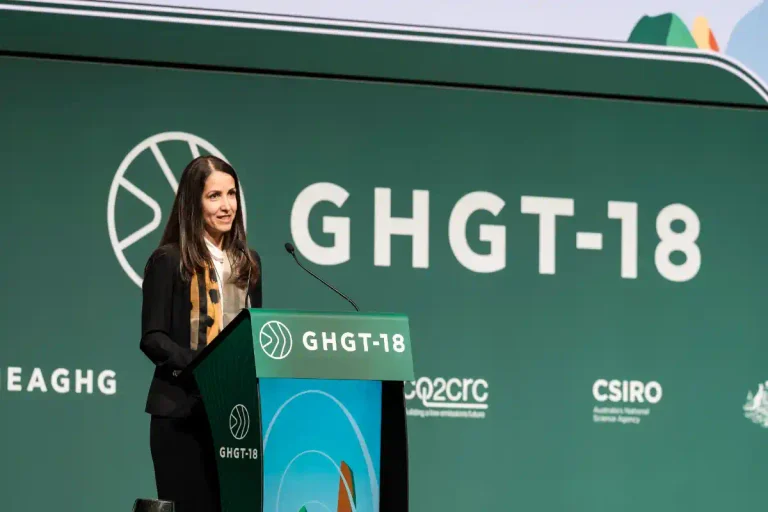
GHGT-18 Day 4 Plenary – Technology evolution to real-world implementation
News & Blogs
29 October 2026

Scaling technology from the lab to full system integration
Professor Andrea Ramírez Ramírez of TU Delft explored the importance of techno-economic and system-wide analyses when evaluating technology deployment.
She said that integrating new technologies at scale requires a change in thinking. She described three scopes of assessment: technology (a single device or process), plant (the production site and value chain) and system (clusters and energy systems).
These scopes affect one another. The broader impacts of the system will alter plant design, and changes to technology within the plant can cause a ripple effect throughout the system. She gave renewable energy as an example. At the technology level, the cost of generation is low, but intermittent generation has downstream implications. One question is whether the associated system is flexible enough to respond to it. Understanding these system-wide implications is essential to calculating CAPEX and OPEX.
She noted that, although it is often said that the cost of technology decreases over time, cost is a function of the technology’s capacity. The capacity of both the technology and the system, including land use, transport and infrastructure, needs to be considered, as both can affect CAPEX and OPEX.
Analysing the interconnections within an industrial cluster is also essential. This means understanding which resources emitters share, such as heat, CO2 or energy, and how changing one part of the system creates a ripple effect across it. Understanding the broader effects of any new technology requires a holistic view of the ecosystem it sits in.
She closed by describing four aspects that shape life cycle assessments:
- Functional unit – The goal of the study determines the functional unit, not the other way around. A functional unit per kg of product compares products, while one per kg of CO2 compares uses of CO2.
- System boundaries – The boundary depends on the goal, but in principle it should be expanded as far as possible so that burdens are not shifted outside it.
- Time dimension – An ex-ante technology will operate in a future system, so today’s background data can overestimate or underestimate its impacts.
- Environmental impacts – A technology that cuts CO2 can increase water use, land use or resource depletion. The value added lies in revealing these trade-offs.
From ambition to practical progress: Cemex’s decarbonisation programme
In a plenary presentation at GHGT-18 in Perth, Martha Ramos of Cemex set out how the company is working to cut emissions from cement, which it describes as hard to abate. Cemex serves customers in more than 50 countries, employs around 40,000 people, and reported net sales of US$16.1 billion in 2025.
Cemex’s Future in Action programme commits the company to net-zero emissions across Scopes 1, 2 and 3 by 2050, an ambition aligned with a 1.5°C trajectory. It rests on two pillars, Smart Decarbonisation and Responsible Nature, supported by innovation and partnerships, advocacy, and sustainable finance. Citing its 2025 Integrated Report, Cemex reported reductions in specific CO2 emissions of 14% for Scope 1 and 37% for Scope 2 against 2020.
Cemex has reduced its net CO2 emissions per tonne of cementitious product by 34% against its 1990 baseline. Alongside energy and operational efficiency, alternative fuels reached a 32% substitution rate in 2025, with a 2030 target of 55%. The global clinker factor fell to 70% in 2025, with a target of 68% by 2030. Hydrogen injection in kilns is improving combustion and enabling greater use of alternative fuels.
Carbon capture projects
Cemex’s carbon capture portfolio includes two full-scale projects. CO2LLECT at Rüdersdorf, Germany, targets 1.3 million tonnes of CO2 per year. SOMZERO at Alcanar, Spain, has an initial capture objective of more than 500,000 tonnes per year, backed by a €200 million PERTE grant and more than €450 million of initial investment, and is intended to anchor a broader CO2 hub in Catalonia. In the United States, an amine capture pilot is under way at Victorville, California, and a full value chain FEED study at Balcones, Texas.
Shared infrastructure
A central message was that CO2 transport and storage should be treated as public infrastructure. Shared pipeline and storage networks, with rigorous standards and equitable access, would lower barriers and let producers focus capital on capture performance and scale. Examples cited included the Alberta Carbon Trunk Line, Northern Lights, Porthos, and HyNet North West.
Ramos also argued that the wider market must move together, across performance-based codes and standards, predictable policy frameworks, public procurement, and customer demand. As it was put , “Construction is risk-averse by design. Government leadership can help proven alternatives become mainstream.” She closed with a call to innovate, collaborate, and act.
Other articles you might be interested in


Get the latest CCS news and insights
Get essential news and updates from the CCS sector and the IEAGHG by email.
Can't find what you are looking for?
Whatever you would like to know, our dedicated team of experts is here to help you. Just drop us an email and we will get back to you as soon as we can.
Contact Us Now