

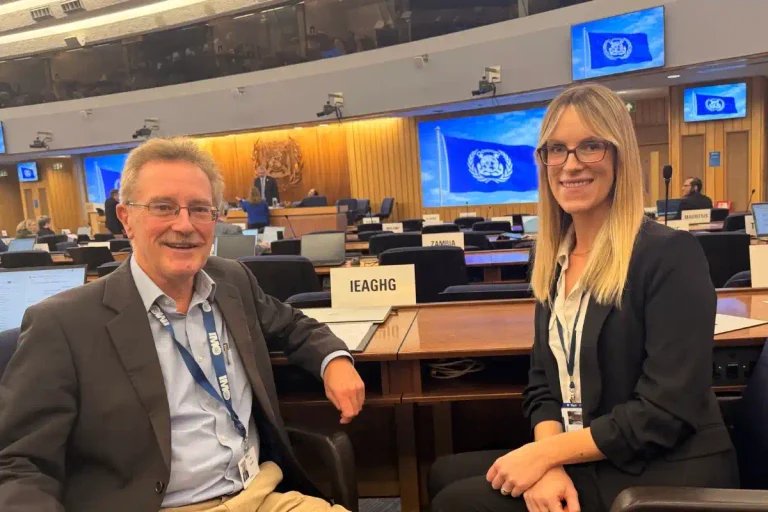
GHGT-18 opens in Perth – Opening Plenary & Keynote Speakers
News & Blogs
26 October 2026
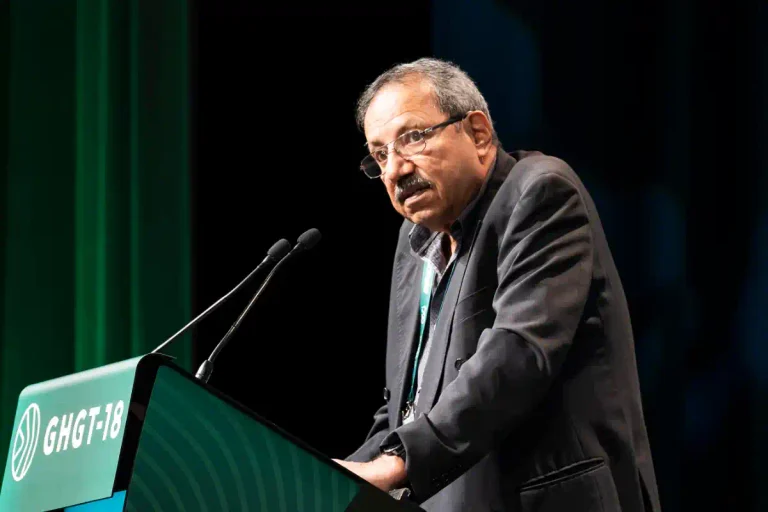
The GHGT-18 conference sessions began on Monday 26th October, as always, with the opening plenary session, which brought together IEAGHG leaders and prominent figures from across the CCUS community.
A Welcome to Country
Tim Dixon, Director and General Manager of IEAGHG, welcomed delegates before stepping aside for the Welcome to Country. Robyn Collard acknowledged the Traditional Custodians of the land on which delegates are gathering and performed this cultural practice to welcome visitors to their Traditional Country, accompanied on didgeridoo by her grandson, Tryse Rioli.
Tim Dixon: a marathon worth running
Returning to the stage, Tim noted that IEAGHG is proud to be custodian of the GHGT series, and that this edition welcomes more than 1,100 attendees from 41 countries. He highlighted the recent UNEP Overshoot Report, which makes clear that we will overshoot 1.5 degrees of warming and that net-negative action is therefore needed. At the same time, positive CCS developments continue around much of the world.
Looking ahead to a busy week, Tim enthused about the 350 oral presentations across seven parallel streams, an eighth stream on business issues, and more than 400 posters that are being presented at GHGT-18. He repeated his comparison of organising GHGT to running a marathon: “it takes a long time, a lot of energy and sometimes a bit of pain. But like a marathon, it is worth it for the rewards of bringing people together and helping CCS & CDR to progress.”
He closed by thanking the conference Destination Partners (Business Events Perth, Crown Hotels and Business Events Australia), Gold Sponsors (INPEX and OGCI), Silver Sponsors (Chevron Australia, Mitsubishi Heavy Industries and TotalEnergies), and the other sponsors.
Kelly Thambimuthu: Australia’s GHGT record
Kelly Thambimuthu, Chair of the IEAGHG programme, noted that Australia now holds the record for hosting the most GHGT conferences since the series began in the 1990s: GHGT-5 in Cairns, GHGT-14 in Melbourne and now GHGT-18 in Perth. He thanked the local co-organisers CSIRO, CO2CRC, Geoscience Australia, AEP and TEG.
A central theme of the conference is sharing knowledge and building partnerships to catalyse the next wave of CCUS deployment, which is crucial to addressing the twin challenges of energy security and climate change. For the foreseeable future, the world needs reliable, affordable and secure energy, but a lower-carbon system is essential. Kelly advocated a “no regrets” approach: accelerating the use of electricity and hydrogen as end-use energy vectors with the highest energy efficiency and low embedded carbon, and ultimately achieving net-zero or net-negative emissions assessed on a cradle-to-grave lifecycle basis. CCUS, he said, is undoubtedly critical to meeting all of these goals, bar none.
Western Australia and industry: ready to play their part
The Hon David Michael MLA, Minister for State Development, commended the 41 countries represented at GHGT-18 and warmly welcomed delegates to the state. Western Australia, he said, is determined to be part of the solution, with its expertise, technology and capability showcased in a growing pipeline of CCS projects. Research, innovation and collaboration remain key, and he encouraged delegates to be ambitious throughout GHGT.
Samantha McCulloch, Chief Executive of Australian Energy Producers, thanked the Minister for his support and noted that Australia is proud to play its part, with the oil and gas industry leading the way in delivering CCS. She highlighted the world-class research that underpins this work and affirmed AEP’s commitment to strengthening partnerships to support future innovation, in which GHGT plays an enormous role. She closed by saying she looked forward to continuing to work with international partners.
Global perspectives: from the IEA, IPCC, GCCSI and CSIRO
In a video keynote, Mary Burce Warlick, Deputy Executive Director of the International Energy Agency, credited much of the recent progress in CCS to targeted government support. Commercial viability is now the main challenge for projects, though new financing approaches are starting to emerge. The industry needs bankable business models, fit-for-purpose legal and regulatory frameworks, and more early-stage funding. CCUS is entering a new phase, with a larger and more diverse project pipeline, and GHGT has long provided an important forum for the community.
Takeshi Enoki, Co-chair of the IPCC Task Force on National Greenhouse Gas Inventories, reinforced that CCS is a core part of our mitigation options, and that CCS, CCUS and CDR are integrated pieces of the carbon management system. The IPCC’s upcoming methodology report on CCUS and CDR, expected by the end of 2027, is a truly global collaboration. It will allow countries to transparently estimate and report emissions, removals, CO₂ captured and stored, and leakage where relevant.
Jarad Daniels, CEO of the Global CCS Institute, told the room that GHGT feels like a professional family reunion. He introduced the GCCSI’s Global Status of CCS Report 2026, which counts 113 operational CCS projects worldwide. While progress is visible, he said, the scale gap remains and there is a long way to go to reach the exponential growth needed. Deployment must continue now and R&D must accelerate. Transport and storage infrastructure is moving centre stage, and an integrated system is needed to make financial and commercial sense, with governments leading through policy that enables financing. His call to action was to turn evidence into deployment by building, sharing and scaling, and he ended with a rousing reminder: “we are all in this together.”
Allison Hortle, Science Director for Energy at CSIRO, rounded out the session by acknowledging the significant role GHGT has played in the development of CCUS. CSIRO, Australia’s national science agency, turns 100 this year. She noted that the value proposition of CCS continues to improve, but the sector must move from first-of-a-kind to Nth-of-a-kind projects and support rapid deployment. CSIRO provides trusted advice and communicates results to reduce public concern. Allison urged delegates not to lose sight of CCUS’s role in meeting decarbonisation goals, and to share lessons learned and communicate with one another to move forward.
The week ahead…
With this morning’s opening plenary complete, IEAGHG is excited for the week ahead. Over the coming days, delegates will hear from hundreds of speakers, explore the posters, and, just as importantly, reconnect with colleagues and build new partnerships across the global CCUS community. If the opening session is anything to go by, it promises to be a week of rich discussion, shared learning and real momentum. We look forward to seeing you around the conference, so please come and say hello!
Other articles you might be interested in


Get the latest CCS news and insights
Get essential news and updates from the CCS sector and the IEAGHG by email.
Can't find what you are looking for?
Whatever you would like to know, our dedicated team of experts is here to help you. Just drop us an email and we will get back to you as soon as we can.
Contact Us Now