

Australia’s Carbon Advantage: Turning Geology and Engineering Expertise into an Investable CCS Industry
News & Blogs
27 October 2026
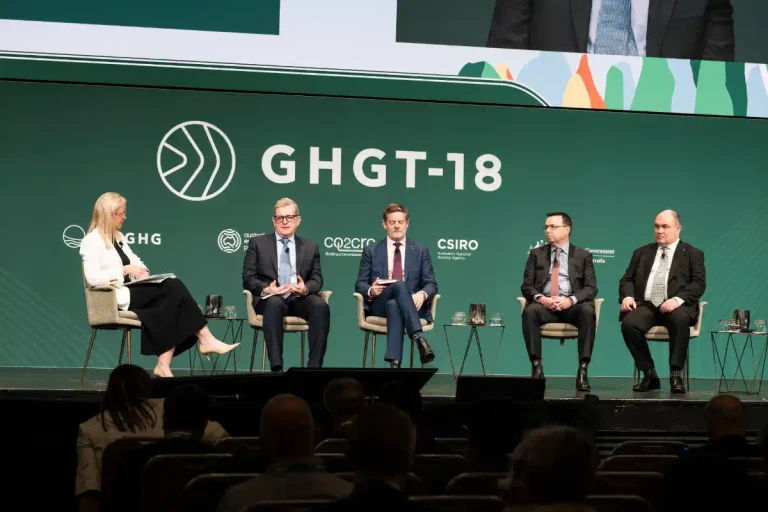
The Day 2 plenary session of GHGT-18, moderated by Samantha McCulloch, Chief Executive of Australian Energy Producers (AEP), opened with a formal acknowledgment of the Ngunnawal Nation as the traditional custodians of the land, paying respect to their elders past, present, and emerging. Framing the day’s strategic dialogue, she highlighted Australia’s unique, world-leading position in Carbon Capture and Storage (CCS). The nation is endowed with extraordinary, high-quality geological storage resources, supported by 18 years of continuous subterranean research and injection experience at CO2CRC’s Otway facility, and underpinned by world-class scientific institutions including CSIRO and Geoscience Australia. With two major commercial projects—Chevron’s Gorgon CCS and Santos’s Moomba CCS—now operating at scale, Australia stands at a pivotal junction in the global energy transition.
The Strategic Pivot: From Pioneers to Hard-to-Abate Scale
While these pioneering facilities demonstrate that large-scale industrial carbon permanent storage is operational today, the central imperative facing industry leaders and policymakers is scaling beyond first-of-a-kind deployments. The panel addressed the strategic pivot required to expand the next wave of multi-user industrial CCS hubs. This expansion carries a dual mandate: decarbonizing Australia’s domestic hard-to-abate industrial assets—including LNG, chemical, and heavy manufacturing facilities—and supplying regional carbon management services to Asia-Pacific trading partners that lack equivalent geological storage resources.
Commercial Breakthroughs & Project Updates: Frontline Insights
Moomba
Richard Hinkley, Vice President at Santos, detailed the operational execution and policy drivers behind the Moomba CCS project in South Australia’s Cooper Basin. Engineered as a commercial infrastructure conversion rather than a greenfield project, Moomba serves as a global benchmark for low-cost abatement:
Moomba have achieved a world-leading total lifecycle cost of $30/tonne by converting legacy oil and gas assets—including depleted underground reservoirs, existing wellheads, and gathering pipelines—avoiding the punitive capital burdens of first-of-a-kind facility construction. Moomba’s economic viability benefited from taking Final Investment Decision (FID) prior to the implementation of the updated Safeguard Mechanism. This historical policy window enabled the project to secure a direct capital grant from the federal CCUS Development Fund and qualify for Australian Carbon Credit Units (ACCUs) under Clean Energy Regulator methodologies. This dual policy support de-risked the asset, enabled sustainable project financing, and accelerated development pace—a stark contrast to today’s framework, which offers zero direct capital grants for CCS infrastructure.
Operating at 95% uptime in the first half of 2026, Moomba has safely injected 2.5 million tonnes (MT) of CO2 to date with 100% compliance across all Monitoring, Measurement, and Verification (MMV) protocols without incident.
Situated in the desert 1,000 km north of Adelaide, Moomba taps into a Cooper Basin storage capacity of 20 MT/year for 50 years. To unlock this basin for external and international emitters, Santos is planning a 720 km pipeline connecting Moomba to Port Bonython—a coastal export/import terminal 700 km from Moomba that currently handles LPG exports. This pipeline link will convert Moomba from an isolated field asset into a regional carbon management highway.
Gorgon
Kynan Scarr provided a progress report on Chevron’s Gorgon CCS facility off the coast of Western Australia, the nation’s flagship offshore abatement project:
Gorgon has safely stored over 13 MT of CO2 since initiating injection in August 2019, marking seven years of continuous operation. The system remains on track to inject more than 100 MT over its total lifecycle. Gas stream extraction of CO2 from offshore gas fields, pipeline transmission, high-pressure compression, and well injection mechanics continue to operate reliably.
Injecting into the deep, confined Dupuy saline aquifer requires active reservoir pressure management by extracting formation water and reinjecting it into a shallower, regionally extensive aquifer. The primary technical bottleneck experienced was solids production from water extraction wells, which caused clogging in water injection wells and restricted surface filtration facilities. Chevron has executed well interventions and completed surface facility upgrades across its pressure management drill centers, clearing the engineering path to increase injection rates toward maximum design capacity in the coming years.
Bonaparte
Steve Ovenden, Vice President at INPEX, outlined the phased execution strategy for the Bonaparte CCS project in the Northern Territory, establishing a commercial blueprint for shared regional infrastructure:
Phase 1 (Foundation Anchor): Capturing and storing process emissions from the Ichthys LNG facility to achieve a 40% reduction in plant emissions, establishing the baseline volume required to underwrite primary capital expenditure.
Phase 2 (Domestic Hub Expansion): Expanding capacity to aggregate local industrial emissions across the Darwin industrial zone (including backfill projects like Barossa).
Phase 3 (Asia-Pacific Regional Hub): Deploying a Floating Storage and Injection (FSI) unit for direct vessel-to-field offshore shipping, decoupling storage capacity from onshore pipeline landfall limits and directly connecting international emitters to Australian geology.
Geological Appraisal & Corporate Alignment: Unlike depleted reservoirs backed by decades of historical production and pressure data, greenfield saline aquifers like Bonaparte require dedicated, high-CAPEX offshore appraisal drilling to prove long-term containment. Minister King’s formal declaration of the Bonaparte saline storage formation marked a critical milestone, confirming storage integrity. Following Woodside’s exit, the project entered Front-End Engineering Design (FEED) under aligned ownership between INPEX and TotalEnergies, matching the ownership structure of the Ichthys LNG end-customer.
Yara Pilbara
Laurent Trost COO of Yara Pilbara, spoke about their operating an 800,000-tonne per annum standalone ammonia plant in Karratha, Western Australia, supplying approximately 5% of the world’s tradable ammonia and producing 45% of the local Pilbara mining region’s technical ammonium nitrate explosive supply. However, the facility emits 1.6 million tonnes of CO2 annually—representing roughly 2% of Western Australia’s total emissions. Fortunately, about 1.2 million tonnes of this CO2 is emitted as a pure, easy-to-capture process byproduct. Given the plant’s proximity to viable geological storage options—including depleted offshore gas fields and saline aquifers—feasibility studies demonstrate that implementing CCS is technically straightforward and capable of abating 75% of the plant’s total carbon footprint in a single project.
Despite this technical readiness, the project faces severe economic hurdles because capturing and storing CO2 represents a purely additive cost without an existing global market premium for lower-carbon ammonia. Implementing CCS would add approximately $150 per tonne to the plant’s baseline $300 per tonne production cost—a 50% cost increase—which cannot be offset by domestic Safeguard Mechanism credits valued at $35–$37 per tonne. This commercial gap highlights a stark policy contrast: while Yara received $47.5 million in public funding for a $110 million, 10 MW renewable electrolyser project that addresses only 0.9% of its hydrogen needs, no direct government capital support exists for CCS despite its capacity for 75% emissions abatement. Nevertheless, a major economic opportunity exists in exporting low-carbon ammonia to Japan and South Korea for power plant co-firing to displace coal, provided Australia establishes technology-agnostic capital incentives and formal bilateral transboundary trade agreements to de-risk the investment
Policy Hurdles & Strategic Imperatives: Bridging the Commercial Gap
The discussion navigated towards current policy and regulatory and strategic direction, and the following key messages emerged.
Navigating Australia’s regulatory framework requires a lengthy and complex timeline. For instance, INPEX mapped out that getting a CCS project like Bonaparte operational involves 8 years and 125 separate approvals, including up to 4–5 individual Environmental Impact Statements (EIS). While Australia’s offshore CO2 storage framework has existed for over 20 years, actual commercial implementation is only now testing the system.
CCS is explicitly excluded from Australia’s $30 billion Clean Energy Finance Corporation (CEFC) green bank, which industry leaders described as “mind-boggling” given that net-zero modelling relies heavily on CCS.
Government funding heavily favours renewable hydrogen and green power over CCS. Yara Pilbara highlighted that their 10 MW electrolyser received $47.5 million in government grant funding (for a $110 million project) to address just 0.9% of their plant’s hydrogen needs. In contrast, no direct government funding is available for CCS, which could abate 75% of the plant’s total emissions.
While the Safeguard Mechanism mandates a 4.9% annual emissions reduction rate, it acts as a compliance penalty mechanism rather than providing capital expenditure support for the high upfront costs of CCS infrastructure. Because CCS projects take up to 8 years to build, industrial emitters face mounting compliance penalties long before their abatement projects can come online.
Australia possesses world-class storage geology and legal frameworks, but lacks a centralized National CCS Strategy to de-risk shared infrastructure and support first-mover commercial hubs.
Expanding CCS into a regional carbon management service requires formal bilateral trade agreements with Asian partners like Japan and South Korea to import CO2. Panelists warned that without rapid policy progress on cross-border transport, Australia risks losing regional business to competitors like Malaysia and Indonesia.
Conclusion: A Unified Call for Action
The plenary concluded with a panel synthesis detailing the core policy shift required to transform Australia’s geological potential into an investable, open-access regional industry:
- Technology Neutrality over Idealism: Federal policy must become technology-agnostic and stop letting “the perfect be the enemy of the good.” Policy frameworks must prioritize rapid, absolute emissions reductions (tonnes of CO2 abated) rather than picking specific technology pathways.
- A Dedicated National CCS Strategy: Government must urgently formulate a National CCS Strategy designed to close the commercial gap for first-mover shared infrastructure hubs. Removing the statutory ban on CCS within the Clean Energy Finance Corporation (CEFC) represents an immediate, high-impact policy change.
- Transition to Open-Access Multi-User Networks: Policy settings must facilitate the transition away from single-company “customer-developer” assets toward open-access, multi-user transportation and storage networks. Backed by clear transboundary regulation, these networks can aggregate disparate domestic and international industrial emissions into world-class storage basins like the Cooper, Bonaparte, and Browne basins.
Other articles you might be interested in

Get the latest CCS news and insights
Get essential news and updates from the CCS sector and the IEAGHG by email.
Can't find what you are looking for?
Whatever you would like to know, our dedicated team of experts is here to help you. Just drop us an email and we will get back to you as soon as we can.
Contact Us Now