

London Convention and London Protocol Annual Meeting LC48/LP21 meeting Meeting 2026
News & Blogs
15 October 2026
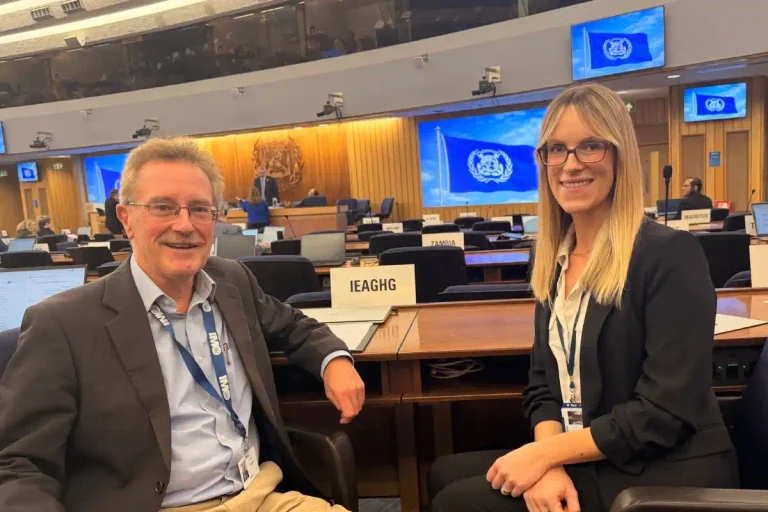
The London Convention and London Protocol are the international treaties that protect the marine environment. The London Protocol was amended in 2006 to allow offshore geological storage for CCS, and in 2009 to allow export of CO2 (but this is not in force yet), and in 2019 to allow countries to apply the 2009 export amendment. IEAGHG has played a role in all of these and is an accredited Observer – and the only CCS organisation regularly at these meetings.
At this annual meeting on 5–9th October (LC48/LP21), it was noted that it was the 20th anniversary of the London Protocol coming into force in 2006. Much time was spent this week on marine geoengineering (MGE), and there was the usual agenda item on CCS development in which IEAGHG provided a formal paper to update on global developments relating to offshore CCS.
CCS
As usual, this meeting asked for updates on the acceptance and ratification of the 2009 CO2 Export Amendment and use of the 2019 Provisional Application of the Export Amendment. The number of countries who have accepted the 2009 Amendment is now seventeen: Norway, UK, Netherlands, Iran, Finland, Estonia, Sweden, Denmark, Korea, Belgium, Switzerland, Australia, Croatia, Spain, France, and most recently Japan and Germany (an increase of two from last year). So, there is progress, but it is still a long way from coming into force as it needs 37 of the 56 Parties to the Protocol to accept it. Hence the need for the 2019 Provisional Application of the 2009 Export Amendment, so that countries can use this 2009 amendment now for exporting/importing CO2 for CCS. There are now fourteen countries who have submitted declarations to the IMO: Norway, Netherlands, Belgium, Denmark, Korea, Sweden, UK, Switzerland, Australia, Finland, Spain, France, Japan and Germany (an increase of two from last year). There are sixteen bilateral agreements in place, many with Norway (an increase of six from last year).
Country updates on the Export Amendment were provided by Sweden, Japan, UK, the Netherlands, Norway, Germany, and Australia. So, there is increasing activity on transboundary CCS for offshore storage.
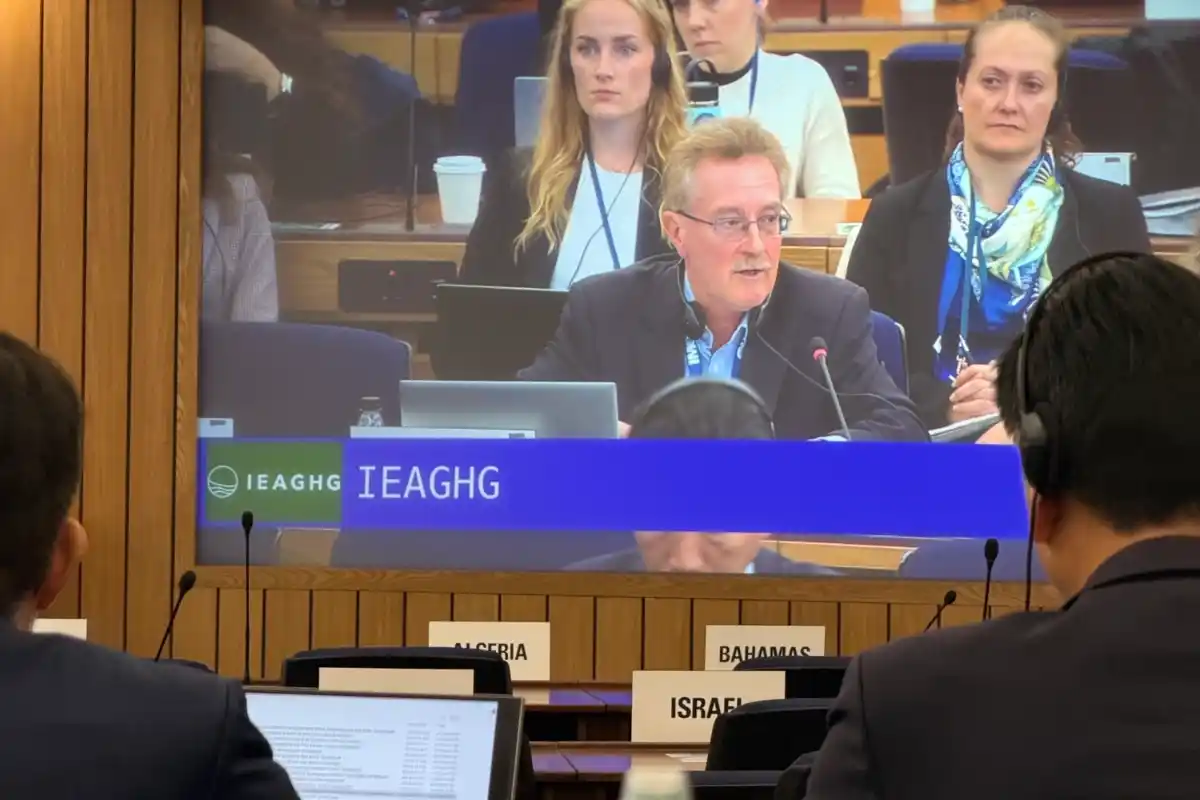
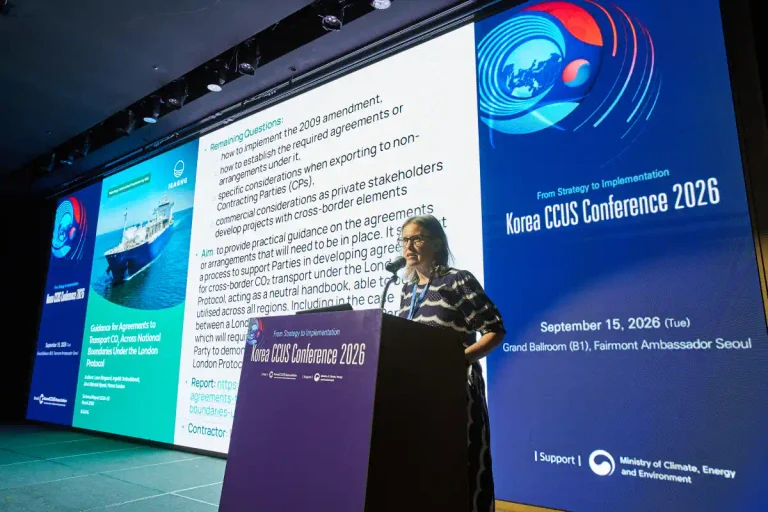
IEAGHG had provided a formal paper to LC48 (LC48 INF.4) and briefly presented this in plenary. This provided updates on developments in offshore CCS, specifically the results from the 8th Offshore CCS Workshop (IEAGHG report 2026-TR05) and the IEAGHG report on Guidance for Agreements to Transport CO2 Across National Boundaries under the London Protocol (IEAGHG report 2026-02), which was presented in plenary at lunchtime by the study contractor IOM Law. IEAGHG also noted the 20th anniversary of the first CCS amendment to allow offshore CO2 geological storage (2006), and described the projects enabled as a result. Finally, IEAGHG informed the meeting on the recent UNEP Overshoot report, which highlights that we will overshoot 1.5°C in a decade, and that to return we will need a lot of CO2 removals and hence more geological storage onshore and offshore. Several countries thanked IEAGHG for the update, including Norway, Ghana, Italy, and Greenpeace thanked IEAGHG and followed up with some more detailed questions.
Presentations were also made at lunchtimes by TNO for the Netherlands on experiences with offshore monitoring, and by Germany on their assessment of their own offshore storage by the GEOSTOR project led by GEOMAR. This found that the Bunter sandstone formations in the German EEZ could potentially store a significant amount of the CO2 that will be captured in Germany. Germany has a new legal framework for transport and offshore storage of CO2, the German Carbon Dioxide Storage and Transport Act (KSpTG), which came into force in November 2025. It was noted that this is only for CO2 from hard-to-abate sectors, not from power generation.
The IMO Secretariat encouraged countries to accept the 2009 amendment, noting that CCS is an effective climate change mitigation technology and contributes to meeting the Paris Agreement targets, and to notify the Secretariat of any agreements or arrangements.
Marine Geoengineering
Much work is underway on MGE. The 2013 amendment to the London Protocol intends to bring into force regulation of MGE, prohibiting it except for research purposes, and in those cases needing an assessment framework for the issuing of permits. The countries were reminded of the importance of having more acceptances of the 2013 amendments to the Protocol, as the entry into force of the amendment would be the best way to allow the Contracting Parties to progress the work regarding MGE. In recent years, the Parties had adopted three statements, two by the governing bodies in 2022 and 2023 and one by the Scientific Group in 2022, all highlighting the urgency of this work against the background of the rapidly growing private sector interest in MGE techniques. These can be seen in a new specific IMO web area for MGE at Marine geoengineering.
Since last year, there has been an intersessional correspondence group on MGE and a legal group on MGE. This topic took up more time than any other subject in this annual meeting.
The meeting noted the slow acceptance of the 2013 Amendment to control MGE under the London Protocol. Only nine countries have accepted (Australia, Croatia, Denmark, Estonia, Finland, Germany, Netherlands, Norway, UK), which is the same as last year, and for it to come into force 37 are needed out of the 56. Work has been underway to revise the assessment framework for ocean fertilisation, and to create new assessment frameworks for ocean alkalinity enhancement and for biomass sinking. All three have been approved at this LC48, but restricted to legitimate scientific research, explicitly deferring commercial-scale deployments due to ecosystem uncertainty, and also requiring rigorous risk assessments, post-project reviews, and consultations with Indigenous Peoples (IMO Adopts Assessment Frameworks For Marine Carbon Removal).
Kenya gave a presentation at lunchtime on their work on MGE, which involved workshops with other African countries and microcosm experiments, in order to develop a roadmap for policy and research for MGE in Africa.
MGE will continue to be a hot topic with much work to be done in the London Protocol for the foreseeable future, as more research and commercial activities take place around the world, and as the London Protocol intersessional working group continues.
As in recent years, IEAGHG was the only CCS-specific organisation present at the London Convention meeting. IEAGHG’s Tim Dixon attended the CCS and some of the MGE parts, Sam Neades attended the CCS part, and Jasmin Kemper attended the MGE parts (virtually).
Public information on the London Convention is available at Convention on the Prevention of Marine Pollution by Dumping of Wastes and Other Matter (imo.org). For background on the CO2 Export Amendment, Resolution and guidelines, see IEAGHG report 2021-TR02 Exporting CO2 for Offshore Storage – The London Protocol’s Export Amendment and Associated Guidelines and Guidance – IEAGHG.
Tim Dixon, Sam Neades, Jasmin Kemper
Other articles you might be interested in

Get the latest CCS news and insights
Get essential news and updates from the CCS sector and the IEAGHG by email.
Can't find what you are looking for?
Whatever you would like to know, our dedicated team of experts is here to help you. Just drop us an email and we will get back to you as soon as we can.
Contact Us Now