

GHGT-18 Day 3 Plenary Session: Key Takeaways
News & Blogs
28 October 2026
Shiwang Gao – China Huaneng Clean Energy Research Institute
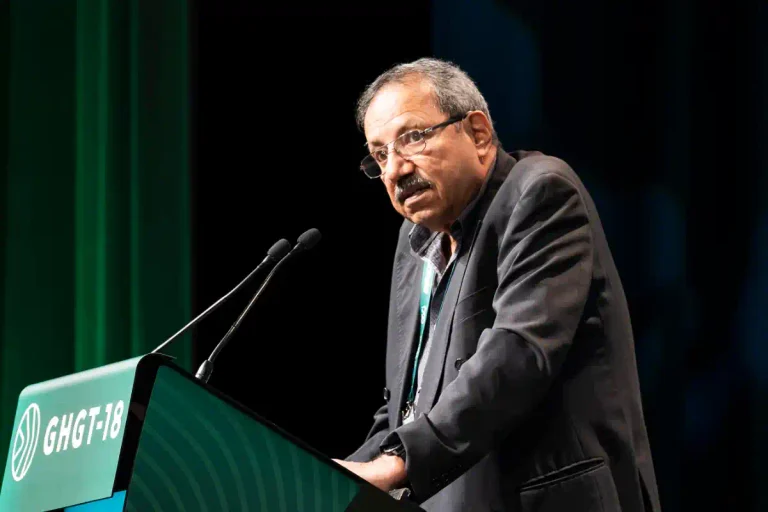
Shiwang Gao (Director, State Key Laboratory of High-efficiency Flexible Coal Power Generation and CCUS & Deputy Chief Engineer, China Huaneng Clean Energy Research Institute) presented learnings from the Longdong CCUS project. Through its Clean Energy Research Institute (CERI), China Huaneng is leading on CCUS developments with 20 years of experience, with their amine-based HNC solvent now in its 4th generation and in commercial use since 2015.
The newest generation is characterised by low energy demand, low solvent losses and low degradation. 2008 saw China’s first CO2 capture pilot on coal power with a scale of 3000 tpa, and in the two decades since a scale-up to 1.5 Mtpa has been achieved, making Longdong the largest CCUS project on coal power in the world. The facility sits on a balancing power unit (2x1GW ultra-supercritical coal with 4.5GW wind and 1.5GW solar), where flexibility is a design requirement – not an option. The facility commenced operation in September 2025, with its performance verified by China’s National Institute of Metrology.
CERI is also active in ISO on standards related to absorption performance parameters and amine emissions monitoring. Construction took 22 months, and the column design saved costs and land footprint but required very careful design of the gas-liquid distribution. The plant can achieve a capture efficiency of 90.65% (at a capture rate of 187.5 t/h), requiring ~2.2 GJ/t for solvent regeneration and resulting in a capture cost of $30/t of CO2.
Degradation of the amine-based HNC solvent is kept low by shifting the equilibrium between active amine and degradation intermediates back towards the working amine. Capturing the 1.5 Mt only reduces the net efficiency of the host power unit from 41% to 39.2%, and this is estimated to be further reduced to 34.4% for full-flow capture. Next steps will include longer-term CCUS operation with lower net energy penalty and flexible operation.
Christine Irvin – Oxy Low Carbon Ventures
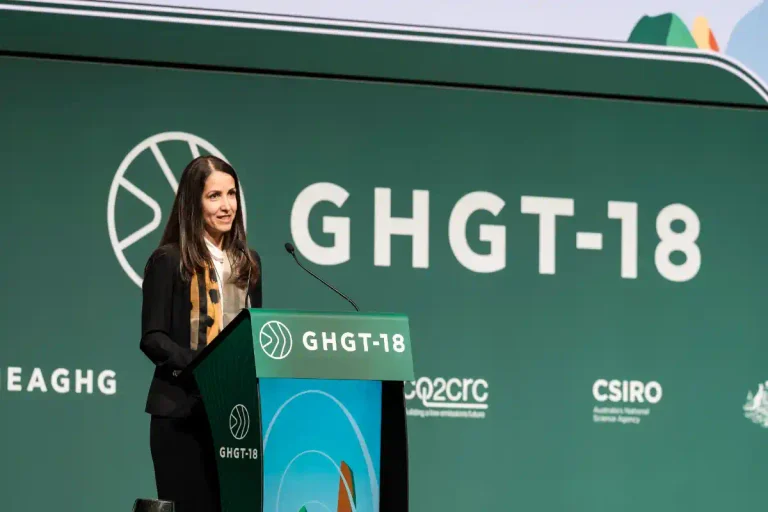
Christine Irvin (Director, Direct Air Capture, Oxy Low Carbon Ventures) presented the team effort of Oxy Zero In, 1PointFive and Carbon Engineering in delivering DAC demonstration at scale. The Carbon Engineering Innovation Centre played a crucial role early on in testing ideas, gathering data and rapid technology proof-of-concept work, sometimes not so much for the air capture process itself as for plug-in equipment testing.
Carbon Engineering’s first DAC pilot was built in 2015 and provided the basis for the Stratos project, which scaled up DAC technology to 0.5 Mtpa. Stratos’ process uses a coupled liquid and solid loop, with the calciner for the CaO-based solid loop being oxy-fired, avoiding issues with SOx and NOx. 100% of the captured CO2 is sent to geological storage, with all measurements for resulting CDR credits 3rd-party verified. Most of the process design time was spent on designing the air contactor. This process also included moving from a large number of smaller contactors to a smaller number of larger contactors. Total costs for the whole facility, which is powered by newly built solar PV, come in at ~$1bn.
Steps for the future will include building a new technology development campus and rolling the technology out globally. For this, costs will need to be brought down, compliance measures established, and the markets widened. Policy will be a keystone and needs to take into consideration that technologies change at a fast pace and that there are multiple pathways. Long-term offtakes are needed, but those in turn need policy certainty.
Christine closed the presentation with a quote from Theodore Roosevelt: “The credit belongs to the man who is actually in the arena, whose face is marred by dust and sweat and blood, who strives valiantly, who errs, who comes short again and again, because there is no effort without error and shortcoming…”, inviting all attendees to reflect on the question: “What is my place in this arena?”
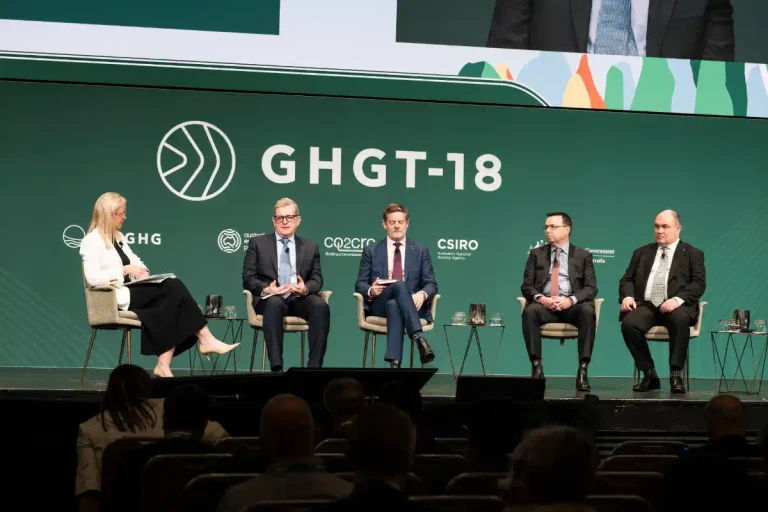
This plenary session was chaired by Dr Dietmar Tourbier (Director, Energy, CSIRO).
Other articles you might be interested in
Get the latest CCS news and insights
Get essential news and updates from the CCS sector and the IEAGHG by email.
Can't find what you are looking for?
Whatever you would like to know, our dedicated team of experts is here to help you. Just drop us an email and we will get back to you as soon as we can.
Contact Us Now