

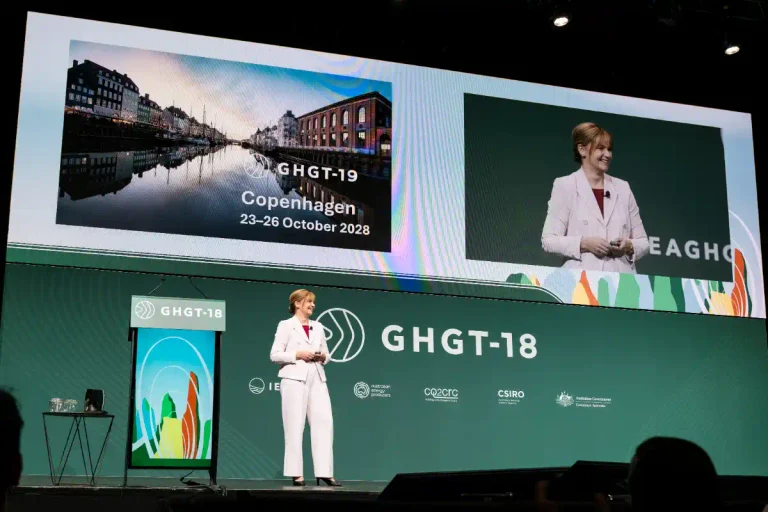
GHGT-18: Ending on a High Note with the Future Leaders of CCUS
News & Blogs
30 October 2026
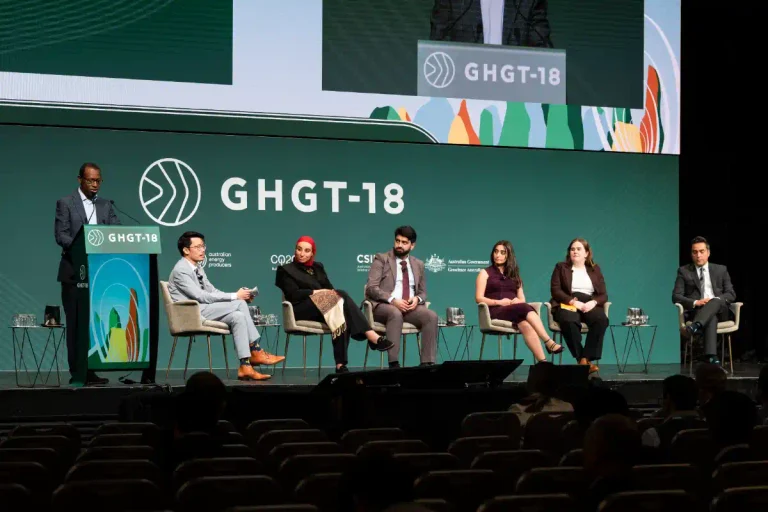
How do you end a great conference? By bringing out the future leaders!
What an inspiring and thought-provoking way to bring GHGT-18 in Perth, Australia, to a close!
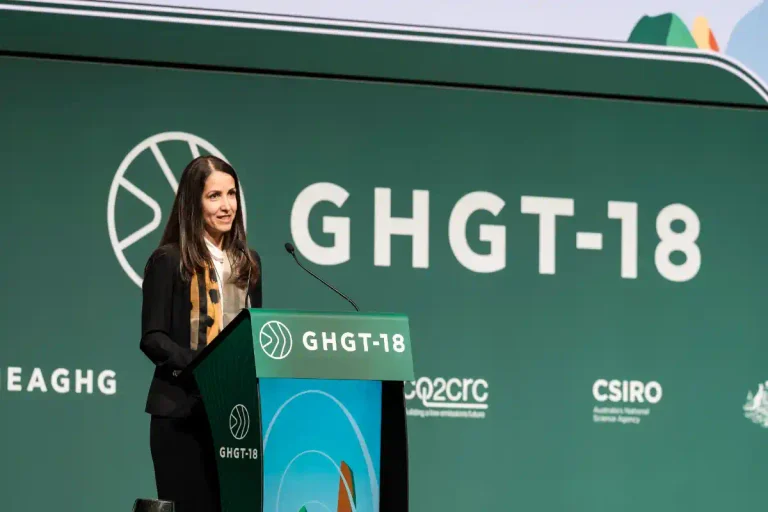
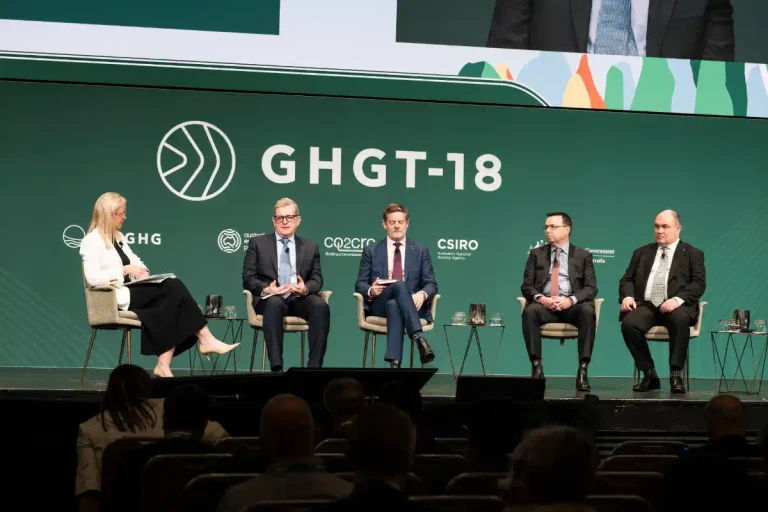
The Future Leaders Panel, chaired by Alex Cruz (Baker Hughes), brought together five emerging leaders in carbon capture, utilisation and storage (CCUS): MennatAllah Labib (IEAGHG), Asama Mazhar (Cemex), Claire Patterson (Geoscience Australia), Elsy T. Milan (Imperial College London) and Ehsan Soroodan (CSIRO).
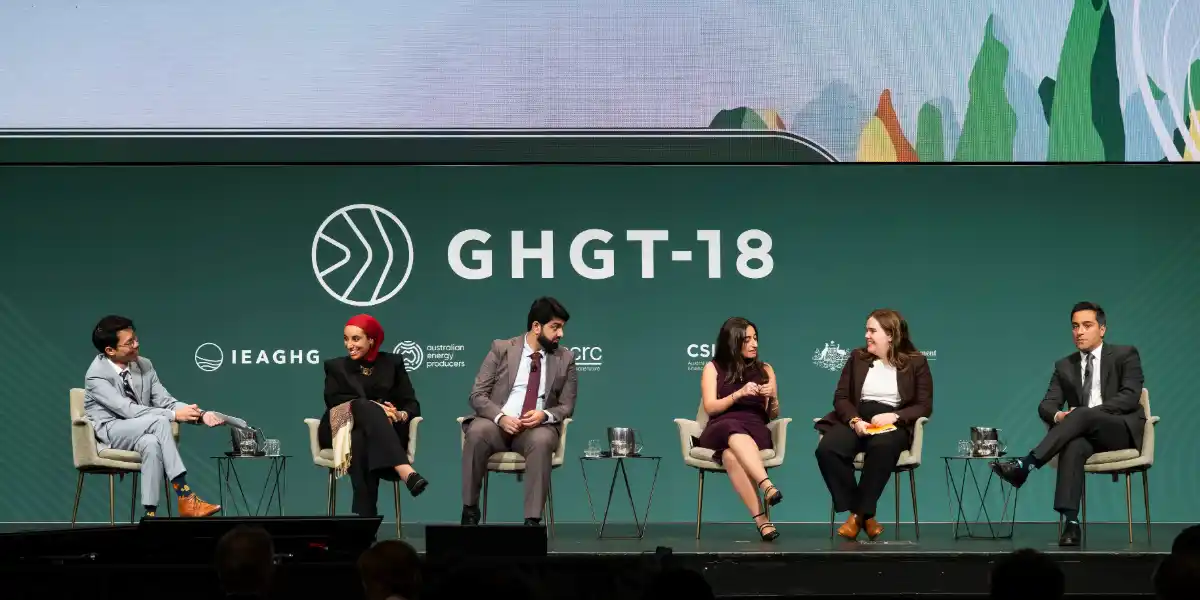
From left to right: Alex Cruz, MennatAllah Labib, Asama Mazhar, Elsy T. Milan, Claire Patterson and Ehsan Soroodan.
The session offered a refreshing mix of personal experiences, insightful reflections and forward-looking perspectives on the future of CCUS and its role in global decarbonisation.
The discussion began with the panellists sharing their backgrounds and personal journeys into climate change mitigation. From formative experiences to the motivations that shaped their career choices, their stories highlighted the diverse pathways that have brought talented young professionals into the CCUS sector, united by a shared commitment to addressing one of the world’s most pressing challenges.
One of the strongest messages emerging from the discussion was the importance of effective science communication. As scientists, engineers and technical experts, we often communicate within circles where complex concepts and technical terminology are readily understood. However, meaningful engagement requires us to go beyond these circles and communicate the science in ways that are accessible, relatable and understandable to a much broader audience.
The panellists emphasised that communicating the science behind CCUS should not be confused with lobbying for the technology. Rather, it is about presenting evidence-based facts clearly, confidently and responsibly, helping broader audiences understand what CCUS can achieve, its limitations and the circumstances in which it can contribute most effectively to decarbonisation.
This naturally led to another important point: CCUS should not be unnecessarily pitted against other low-carbon technologies. The energy transition is not a competition between individual solutions. Different technologies have distinct strengths, limitations and applications, and their contributions must be considered within the wider energy system. What works best in one industrial or energy-system context may not necessarily be the most suitable solution in another. The focus should therefore be on how these technologies can complement one another in delivering effective and sustainable decarbonisation.
Another particularly powerful takeaway was the need for CCUS professionals to look beyond their technical bubbles. There is sometimes a tendency to become so immersed in solving a particular technical challenge that we lose sight of the wider system in which that solution must operate. Addressing one technical barrier, however significant, does not necessarily resolve the broader challenges of deployment.
The discussion reinforced the importance of developing a more holistic understanding of CCUS, extending beyond individual areas of technical expertise to encompass policy, regulation, economics, infrastructure and the wider energy transition. In this regard, CCUS experts should increasingly approach challenges through the lens of systems integration, recognising the interdependencies between technologies, markets, policies and societal needs.
Political will was also acknowledged as a critical enabler. Scientific advances and technological readiness alone are insufficient to deliver deployment at scale without supportive policies, clear regulatory frameworks, investment certainty and sustained political commitment.
The discussion also explored what motivates emerging professionals and what they would like to see in the coming years. Opportunities to make a meaningful contribution, community outreach and the satisfaction of seeing their professional work align with their personal values were among the important themes.
There was a clear sense of optimism about the future. The commitment, enthusiasm and capabilities of the next generation offer genuine reasons for encouragement.
We have talented, passionate and highly capable young professionals working in this field, and that is something we should be loud and proud about!
It was an engaging, insightful and genuinely uplifting discussion, and a fitting way to conclude a remarkable week at GHGT-18. Above all, the Future Leaders Panel served as a powerful reminder that, alongside technological advancements, investing in people, nurturing talent, encouraging interdisciplinary thinking and communicating science effectively are essential to the long-term success of CCUS.
GHGT-18 Student Poster Award
Following the Future Leaders Panel, Tim Dixon, Director and General Manager of IEAGHG, recognised the recipients of the GHGT-18 Student E-Poster Awards. The awards celebrated outstanding research contributions, with submissions assessed against three principal criteria: quality of work and innovation, impact and relevance, and communication and presentation.
Congratulations to the two award recipients:
Aike Albers (Adelaide University) – From Seismic to Storage: Exploring the Carbon Storage Potential of Buried Mafic Reservoirs in the Bass Basin, SE Australia.
Sudip Sharma (Norwegian University of Science and Technology – NTNU) – Multi-Objective Optimisation of Magnetic Induction Swing Adsorption for Electrified CO2 Capture.
Both awards are thoroughly well deserved and recognise the quality, originality and potential impact of their research.
A truly inspiring end to GHGT-18 in Perth!
Other articles you might be interested in

Get the latest CCS news and insights
Get essential news and updates from the CCS sector and the IEAGHG by email.
Can't find what you are looking for?
Whatever you would like to know, our dedicated team of experts is here to help you. Just drop us an email and we will get back to you as soon as we can.
Contact Us Now