

Building CCUS Partnerships in Asia Pacific: IEAGHG Joins UK Industry Delegation to South Korea and KCCUS
News & Blogs
23 September 2026
IEAGHG was honoured to join a UK CCUS industry delegation to South Korea from 14-16 September 2026, participating in a packed three-day programme.
IEAGHG was honoured to join a UK CCUS industry delegation to South Korea from 14-16 September 2026, participating in a packed three-day programme focused on international collaboration, carbon management policy, and the future of carbon capture, utilisation and storage (CCUS) across the Asia Pacific region.
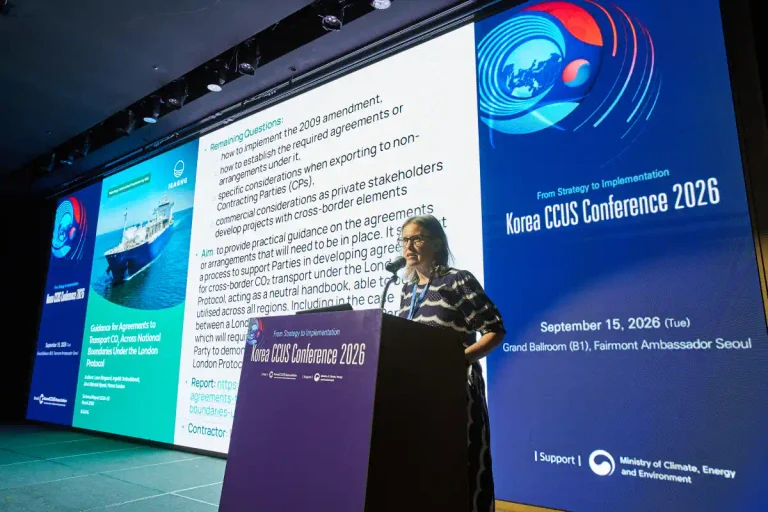
The visit comprised the UK-Korea Partnership Seminar, hosted by the Department for Business, Innovation, Science and Trade (BIST) Seoul at the British Embassy, participation in the Korea CCUS Conference 2026 (KCCUS), and a series of industrial site visits in Ulsan. As part of the conference programme, IEAGHG was also invited to present findings from its recent study, Guidance for Agreements to Transport CO₂ Across National Boundaries Under the London Protocol.
Korea’s Growing Role in Asia Pacific Decarbonisation
South Korea is uniquely positioned to play a major role in the decarbonisation of the Asia Pacific (APAC) region. While the country remains one of the region’s higher per-capita emitters, reflecting its advanced industrial economy, it is also home to world-leading expertise in shipbuilding, steel production, engineering and carbon capture technologies.
The challenge facing Korea is not a lack of industrial capability, but a lack of readily available, appraised CO₂ storage resources. This stands in contrast to other parts of the APAC region, where geological storage potential is more abundant. As a result, international collaboration and the development of cross-border CO₂ transport and storage networks are likely to play a critical role in Korea’s long-term decarbonisation strategy.
With APAC currently responsible for around half of global greenhouse gas emissions, progress in the region will be essential to achieving global climate objectives. Korea’s commitment to climate action, energy security and economic growth is driving an increasingly ambitious CCUS agenda, supported by government, industry and international partners.
The UK’s experience in developing investable, government-backed CCUS clusters and evaluating geological storage resources offers valuable lessons, making collaboration between the two countries particularly timely. As both the UK and South Korea are members of IEAGHG, the organisation was delighted to contribute to these important discussions.
UK-Korea Partnership Seminar
The programme began with the UK-Korea Partnership Seminar at the British Embassy in Seoul.
Opening remarks were delivered by Beth McKendrick, Country Director for BIST Seoul, and Eunsoo Jung of the Korea CCUS Association (K-CCUS), who provided an overview of Korea’s rapidly evolving CCUS landscape. Established in 2021, K-CCUS now represents around 80 member organisations spanning the CCUS value chain.
Delegates heard how South Korea’s CCUS Act was enacted in 2024 and promulgated in 2025, laying the foundation for a future regulatory framework. Work is now underway to develop the detailed rules and guidance required to support deployment, while a national five-year CCUS Master Plan is expected to be published in December 2026.
A recurring theme throughout the seminar was the importance of developing regional CO₂ transport and storage networks. Given Korea’s limited domestic storage capacity, transboundary CO₂ storage is expected to become a critical component of future deployment strategies. In this context, Korea’s globally recognised shipbuilding industry could play a major role in enabling large-scale marine transport of CO₂ across Asia Pacific.
Insights from Industry and Research
Several significant studies were presented during the seminar.
Lara Taylor of Xodus shared findings from the APAC CCUS Regional Assessment Report, funded by the UK Government, while Chris Thackerey of Baringa presented The Role of CCS in Korea’s Low Carbon Future, developed in partnership with Shell.
Baringa’s modelling examined three potential energy transition pathways for Korea: accelerated, practical and headwinds scenarios. Across all three, gas-fired power generation equipped with CCS remained a key component of least-cost decarbonisation pathways, providing reliable low-carbon power capable of balancing the grid during periods of low renewable generation.
One of the standout findings from the Xodus study was the significant cost advantage Korea could realise if additional domestic storage resources are successfully developed. This conclusion was further supported by value chain modelling presented by Hetal Gandhi of Wood Mackenzie.
Delegates also heard an update on the Donghae CCS Demonstration Project from JooKyong Cho of Korea National Oil Corporation (KNOC). The project aims to repurpose the depleted Donghae offshore gas field, which ceased production in 2021 after 18 years of operation, into a CO₂ storage site. Current plans envisage storing approximately 1.2 million tonnes of CO₂ annually, although further storage capacity will ultimately be required to meet Korea’s long-term ambitions.
Lessons in Commercialisation
The seminar also featured valuable perspectives on commercial deployment.
Jasper Wong, CTO of Airhive, outlined developments in direct air capture technology and highlighted the launch of UnionDAC in partnership with Progressive Energy, which intends to supply approximately 60,000 tonnes of captured atmospheric CO₂ annually into the UK’s East Coast Cluster.
Meanwhile, William Stroll of Pinsent Masons shared practical lessons on delivering bankable CCUS projects. A key message was that while the UK provides a useful model, Asia Pacific projects will require bespoke commercial and contractual arrangements to reflect regional circumstances and cross-border value chains. Managing interfaces between capture, transport and storage operators was highlighted as one of the most critical success factors.
The event concluded with remarks from Iona Shaw, Head of Hydrogen and CCUS within BIST’s Renewable Energy Team, followed by an evening reception hosted by British Ambassador Colin Crooks and attended by senior representatives from K-CCUS.
Day Two: Korea CCUS Conference 2026
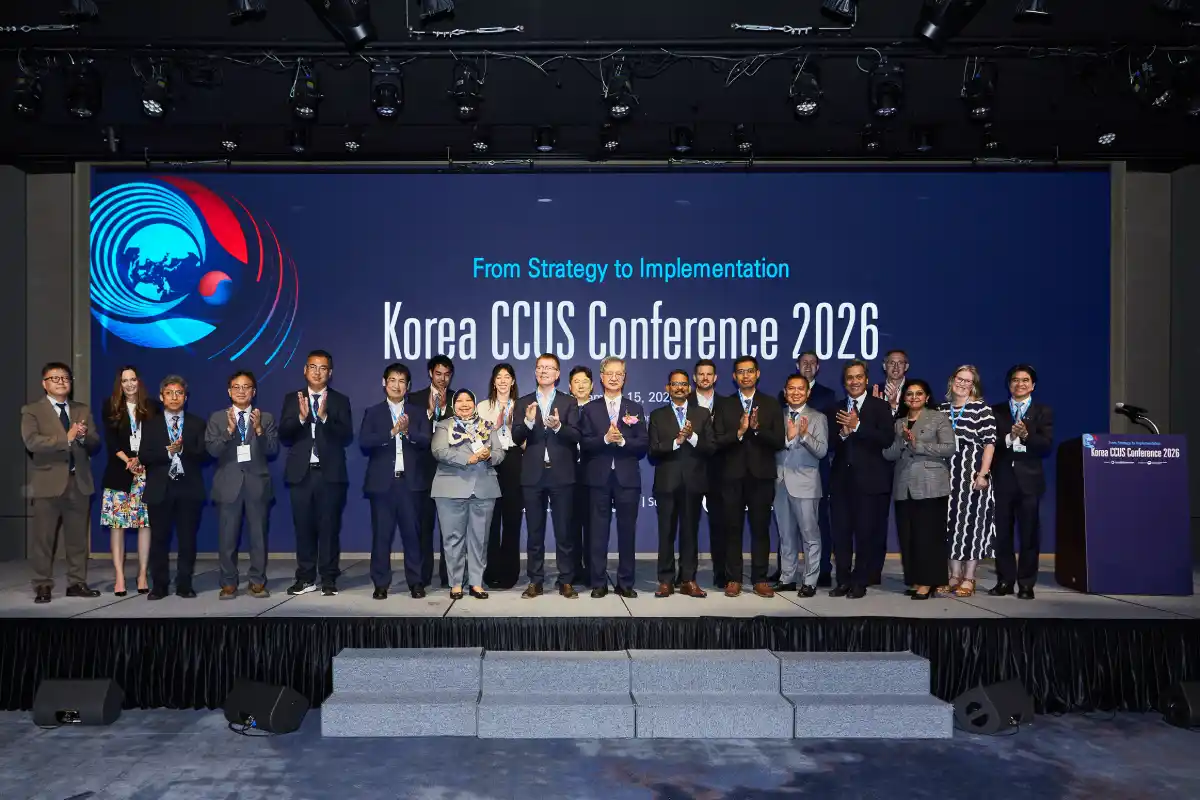
The second day centred on the Korea CCUS Conference 2026 (KCCUS) at the Fairmont Ambassador Seoul.
Hosted by the Korea CCUS Association and supported by Korea’s Ministry for Climate, Energy and Environment, the KCCUS conference brought together government officials, industry leaders, project developers and technology innovators from across the region.
The programme featured four key themes:
- Government perspectives on CCUS deployment
- Implementing large-scale CCUS projects
- Market outlook and commercialisation
- Emerging technologies and innovation
Speakers represented a broad cross-section of the APAC CCUS community, including organisations from Indonesia, Malaysia, Japan, Australia and the United Kingdom, alongside major companies such as Chevron, Shell, Pertamina, Petronas and PTT.
For IEAGHG, the conference provided an excellent opportunity to share insights from its recent publication on transboundary CO₂ transport under the London Protocol.
With Japan, South Korea and Australia all Party to the London Protocol and actively pursuing carbon storage opportunities, cross-border CO₂ transport is becoming increasingly relevant. The report provides practical guidance on the implementation of the 2009 amendment, legal frameworks, commercial arrangements and lessons from emerging international projects. Interest in the topic was strong, reflecting growing momentum behind regional cooperation and international storage solutions.
Day Three: Industrial Visits in Ulsan
The final day took the delegation to Ulsan, Korea’s industrial powerhouse and one of the country’s most significant energy and manufacturing centres.
The delegation visited the Ulsan Port Authority (UPA), East-West Power (EWP), and KEPCO’s carbon capture facilities.
UPA showcased its ambitions to become a leading hub for green shipping, clean fuels and sustainable port operations. As Korea’s primary liquid cargo and energy port, it is expected to play an important role in future CO₂ transportation networks.
At EWP, delegates toured Korea’s first 1 MW-scale post-combustion carbon capture demonstration plant integrated with an LNG-fired power station. The facility captures and liquefies more than 3,000 tonnes of high-purity CO₂ annually, supplying local industrial users while serving as a platform for research, testing and operational learning.
The visit concluded at Korea Institute of Energy Research’s chemical looping combustion demonstration facility, recognised as the world’s first and largest natural gas chemical looping combustion (NG-CLC) plant.
Looking Ahead
The visit highlighted both the scale of the opportunity and the complexity of the challenge facing the Asia Pacific region.
Whether through government-to-government agreements, industrial partnerships, shipping-based CO₂ transport, offshore storage development or emerging technologies such as onboard carbon capture, momentum is clearly building across the region. South Korea’s commitment to collaboration, innovation and decarbonisation was evident throughout the programme.
For IEAGHG, the visit reinforced the importance of international cooperation in accelerating CCUS deployment and achieving net-zero ambitions. With significant developments expected over the coming years, Asia Pacific will undoubtedly be a region to watch.
Other articles you might be interested in
Get the latest CCS news and insights
Get essential news and updates from the CCS sector and the IEAGHG by email.
Can't find what you are looking for?
Whatever you would like to know, our dedicated team of experts is here to help you. Just drop us an email and we will get back to you as soon as we can.
Contact Us Now