

National Carbon Capture Centre
News & Blogs
24 October 2025
At the 68th IEAGHG ExCo Meeting, delegates were invited on a guided tour of the National Carbon Capture Centre (NCCC) in Birmingham, Alabama.
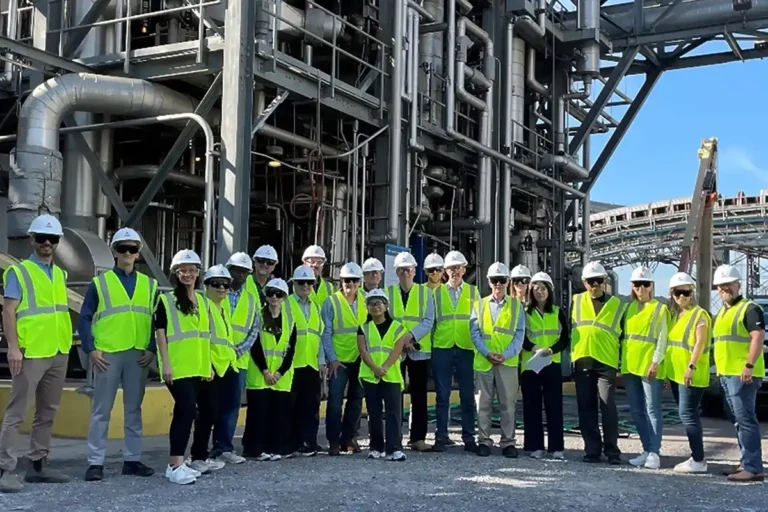
On 15‑16 October 2025, Southern Company hosted the 68th IEAGHG Executive Committee meeting in Birmingham, Alabama. The following day, delegates were invited on a guided tour of the National Carbon Capture Centre (NCCC). NCCC is located adjacent to the ~1.9 GWe coal-fired Gaston Power Plant, around 50 km southeast of Birmingham in Wilsonville.
Established in 2009, NCCC is a world-renowned research facility for advancing a wide range of CO2 management processes. Together with Norway’s Technology Centre Mongstad, NCCC co‑founded the International Test Centre Network (ITCN) in 2011. NCCC focuses on the testing of post-combustion carbon capture technologies being developed by third parties to reduce CO2 emissions from fossil-based power plants and various industrial processes. Carbon conversion and carbon removal technologies, such as direct air capture, are also tested there.
The NCCC is 80% funded through a collaborative agreement with the USDOE’s Office of Fossil Energy and Carbon Management and the National Energy Technology Laboratory (NETL). Remaining funds come from an array of leading national and international sponsors and technology developers. The sponsors, several of whom are also members of IEAGHG, participate in the research, offer industry perspectives and provide technical guidance. To-date, the Centre has accomplished over 160,000 hours of testing, has pilot-tested in excess of 80 technologies, belonging to technology developers from more than seven countries. In fact, access to NCCC facilities is in high demand, with more than 18 technologies in the queue for testing, i.e., around 2 years of testing in the pipeline.
NCCC offers testing at several scales, from lab scale to pilot scale, from 0.005 MWe to 1 MWe. Its lab-scale unit is used mainly to test the capability of materials when exposed to ‘real’ operational conditions. The bench scale equipment can facilitate testing of technologies up to 0.1 MWe. Pilot-scale testing comprises a Pilot Bay, a Pilot Solvent Test Unit and a Slipstream Solvent Test Unit, which can host systems ranging from around 0.05 MWe to 1 MWe. Testing can simulate flue gas from combined cycle natural gas turbines (at 4-5% CO2 by volume) and flue gas from coal-fired units (at 12-14% CO2 by volume). To simulate gas flows from industries such as cement and iron & steel, CO2 concentrations of 20%+ by volume may be accommodated.
The tour was extremely informative and greatly appreciated by all involved. Guiding the tour were John Northington (NCCC Director and Director, Net-Zero Technologies, Research and Development, Southern Company), Mendy Lee (NCCC Assistant Director) and Richard Esposito (Program Manager, Geosciences and Carbon Management, Southern Company).
Other articles you might be interested in

Get the latest CCS news and insights
Get essential news and updates from the CCS sector and the IEAGHG by email.
Can't find what you are looking for?
Whatever you would like to know, our dedicated team of experts is here to help you. Just drop us an email and we will get back to you as soon as we can.
Contact Us Now