


Delivering the Next Phase of CCUS: Key Takeaways from Day One of the CCUS 2025 Conference
News & Blogs
22 October 2025
The CCUS 2025 Conference – the CCSA’s flagship UK conference – opened against a backdrop of unprecedented momentum for carbon capture, utilisation, and storage deployment across Europe and the UK.
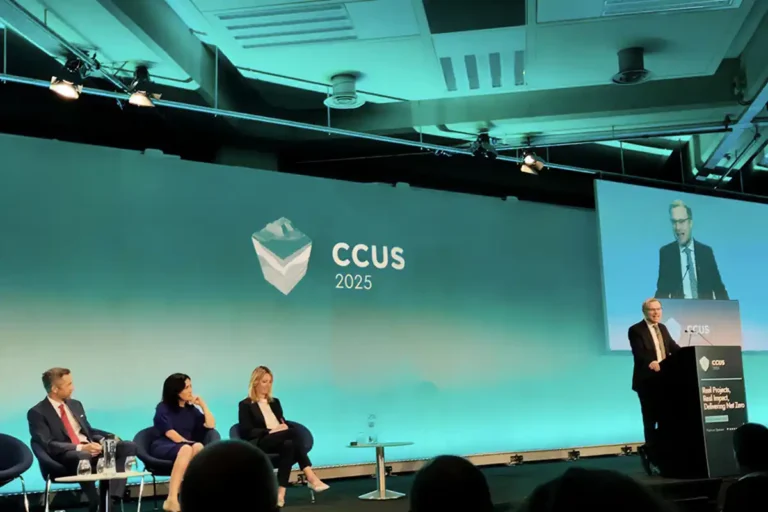
The CCUS 2025 Conference – the CCSA’s flagship UK conference – opened against a backdrop of unprecedented momentum for carbon capture, utilisation, and storage deployment across Europe and the UK. Last year’s focus was on ambition and early policy design. This year, the discussion shifted decisively toward delivery, financing, and large-scale implementation. The room was filled not only with developers and technology providers, but also energy ministers, regulators, investors, national wealth funds, and industrial leaders: a clear signal that CCUS has transitioned from a niche climate technology to a strategic economic and industrial priority.
Two themes were immediately evident from the opening plenary:
- CCUS has moved from planning to execution in the UK, with the first transport and storage projects reaching FID.
- The sector is no longer asking “if” CCUS will scale, but “how fast” and how to build the infrastructure, regulatory certainty, and investment frameworks needed to sustain this next phase.
With ministers, policymakers and industry leaders from both the UK and Norway outlining their national strategies, Day One provided a clear snapshot of where Europe stands on CCUS deployment as we enter the second half of the decade.
Policy Direction: The UK Market Model vs Norway’s Infrastructure-First Approach
The UK and Norway presented contrasting but converging national strategies. Representing the UK, Michael Shanks MP, Minister for Energy at the Department for Energy Security and Net Zero (DESNZ), reiterated the government’s commitment to building a competitive CCUS market anchored in Track-1 clusters and expandable through future licensing rounds. His remarks emphasised a policy shift from subsidised pilots toward a commercially structured system intended to attract private finance. He connected this direction to the country’s broader infrastructure ambitions, noting that sectors such as cement must decarbonise if the UK is to maintain industrial capacity, framing this moment as one in which “the government is in build, baby, build mode.”
In contrast, Lars-Jakob Alveberg, Assistant Director General at the Norwegian Ministry of Energy, outlined Norway’s infrastructure-first approach, in which the state leads early investment in transport and storage capacity to de-risk industrial participation. Norway treats CO₂ storage as national infrastructure, designed for future scalability before full demand materialises.
Both strategies highlight different mechanisms for achieving the same objective: developing CCUS as an integrated, expandable system with cross-sector participation. Where the UK is building markets around anchor projects, Norway is developing anchor projects to underpin future markets.
Financing Signals and FID as a Test of Market Readiness
With national policies in motion, the CCUS 2025 conference’s focus shifted to delivery milestones, particularly Financial Investment Decisions (FID). In the UK, Northern Endurance Partnership (represented by Managing Director Rich Denny) and Net Zero Teesside Power achieved FID in December 2024, followed by Liverpool Bay CCS in April 2025. These FIDs are now treated as stress tests of business model robustness, regulatory certainty and stakeholder confidence.
Developers emphasised that achieving FID required multiple iterations, collaborative risk allocation and adjustments to initial scale assumptions. Reaching FID triggers operational mobilisation, supply chain commitments and workforce scaling, transforming CCUS from theoretical ambition into contractual reality.
Financial institutions such as Lloyds Banking Group and Rabobank framed bankability around five conditions: construction certainty, operational reliability, revenue visibility, sponsor capability and structured risk-sharing. They noted, however, that meeting these conditions without government support remains “extremely difficult” for early projects.
Industry voices also reflected a long-term delivery outlook. Simon Willis, CEO of Heidelberg Materials UK, stated, “CCS is a marathon, not a sprint,” highlighting the need for durable policy support and workforce development. His remark that “CO₂ doesn’t know boundaries” echoed the growing call for interoperability across clusters and cross-border transport networks.
As more clusters approach FID, the maturity of insurance instruments, shared liability frameworks, and standardised commercial models will determine whether CCUS evolves into a scalable asset class or remains confined to subsidised demonstrator projects.
Policy Validation, Political Will and Capital Formation in the UK
The UK’s strategic direction was reinforced by insights from the Climate Change Committee (CCC). Referring to the Seventh Carbon Budget (February 2025), James Richardson CB, Director of Analysis at the CCC, stated unequivocally: “There is no net-zero pathway without CCS.” He addressed common criticisms — cost, uncertainty and fossil fuel lock-in, arguing that the cost of delivering net zero is significantly lower than the economic impact of failing to act, especially when considering industrial competitiveness, energy security and long-term emissions liabilities.
The need for political legitimacy was further reflected in a keynote from Rt Hon Chris Skidmore OBE, Chair of the Climate Action Coalition, who argued that the challenge is “not scientific or technical, but political will.” He emphasised the lack of a compelling public narrative to justify CCS and stressed that sectors such as cement and concrete should be used to demonstrate how CCUS safeguards jobs and secures industrial value chains.
On financing, Chloe Evans of the National Wealth Fund outlined how the UK’s £5.8 billion allocation is being deployed to support Track-1 and Track-2 transport and storage networks, capture projects and financial guarantees. Matthew Harwood of Climate Investments described the UK as “late, but accelerating,” noting that market confidence will only increase through delivery experience: “You learn by doing and in CCS, we have not yet done enough to learn at scale.”
These discussions positioned the UK’s progression as dependent on three interlocking elements: a policy mandate, a politically resilient narrative and a capital structure that supports early risk while enabling scalable replication.
European Outlook: Industrial Protection, Business Cases and Cross-Border Infrastructure
Beyond the UK, European markets are advancing CCUS in response to industrial exposure and regulatory pressure. A regional-focused session featuring Paolo Testini (Snam, Italy), Malte Bornkamm (German Federal Ministry for Economic Affairs and Climate Action) and Aris Tsikouras (Titan Cement Group, Greece) highlighted distinct national drivers.
From Greece, Tsikouras discussed the Kamari plant, targeting production of up to 3 million tonnes of zero-carbon cement with approximately €234 million in EU funding. He warned that European cement faces a serious risk from third-country imports not subject to CCS obligations or carbon pricing, necessitating stronger protection mechanisms and robust carbon border adjustment enforcement. Projected CCUS deployment in Greece is estimated to create over 30,000 jobs and deliver nearly €1 billion in economic benefit.
From Germany, Bornkamm underlined the need for a clear business case within the evolving Carbon Management Strategy, whose core principles were approved by the Federal Cabinet in 2024. He noted that under the EU ETS, industrial emitters “cannot continue to emit indefinitely,” making CCUS increasingly necessary for compliance.
From Italy, Testini outlined the national CCS roadmap centred on the Ravenna hub, designed for multimodal transport through both pipelines and shipping. This positions Ravenna as a potential Mediterranean storage hub with cross-border potential, factoring in geopolitical diversification and regional demand aggregation.
Across all three markets, CCUS is being shaped not only by decarbonisation requirements, but also by industrial protection, cross-chain risk exposure and access to secure storage infrastructure.
CCUS 2025 Conference Strategic Takeaways: The Shape of CCUS Between 2025 and 2030
Day One discussions highlighted three structural trends defining the sector’s trajectory:
1. From Projects to Systems
CCUS is evolving into a network-based infrastructure, not isolated pilots. The transition from project delivery to integrated cluster operation will depend on interoperability, contractual standardisation and shared storage logistics.
2. Finance as a Deployment Catalyst
FID is emerging as the key indicator of market trust. As commercial models become repeatable, the role of public finance is expected to gradually shift from risk coverage to scale leverage.
3. Policy Legitimacy and Industrial Framing
CCUS must be understood as a tool for maintaining industrial competitiveness and securing employment in hard-to-abate sectors. Without societal and political legitimacy, financial and regulatory support may erode before large-scale rollout is complete.
Europe’s future success will hinge on whether CCUS develops as a coherent, interoperable system or a fragmented collection of national schemes.
From a technical research and knowledge-sharing standpoint, the discussions from Day 1 reinforced that the sector’s greatest challenge is no longer technological credibility but effective execution at scale. With projects now advancing through FID and into delivery, success will increasingly depend on how well lessons from first movers are captured, validated and transferred across regions, sectors and deployment phases.
One recurring insight was that execution risk has now replaced technology risk. That places renewed importance on evidence-based evaluation, operational benchmarking and structured dissemination of early project performance and risk management practices. As CCUS clusters expand, system design questions, including storage integrity, cross-chain liability, transport interoperability, and workforce readiness will require coordinated understanding rather than isolated project experience.
Whether CCUS evolves as a coherent, interoperable system or a patchwork of disconnected pilots will largely depend on the quality and transferability of shared learning. As one speaker remarked, “CCS is a marathon, not a sprint.” Sustaining progress over that distance will depend on consistent knowledge cycles and collaborative system development.
As deployment accelerates, the work of structured technical assessment, international cooperation and cross-project learning will remain central to ensuring that early momentum translates into a resilient, scalable and trusted CO₂ management ecosystem.
Other articles you might be interested in



Get the latest CCS news and insights
Get essential news and updates from the CCS sector and the IEAGHG by email.
Can't find what you are looking for?
Whatever you would like to know, our dedicated team of experts is here to help you. Just drop us an email and we will get back to you as soon as we can.
Contact Us Now